 Parking Mate UK
What Is the IAS?
The IAS is a certified Alternative Dispute Resolution body for Phoenix Parking Solutions Parking Charge Notices issued by International Parking Community operators. If Phoenix Parking Solutions belongs to the British Parking Association, the second-stage appeal normally goes to POPLA instead. Council and Transport for London Penalty Charge Notices use statutory tribunals, not the IAS.
The first appeal must be sent to the parking operator. If Phoenix Parking Solutions rejects it, a Standard Appeal can normally be registered with the IAS within 28 days of the rejection. The Standard Appeal is free and its decision binds the parking operator, but not the motorist.
The IAS decides whether the Parking Charge is lawful on the evidence provided and applies the civil balance-of-probabilities standard. It does not cancel a charge for mitigation alone. A medical emergency, breakdown or other serious circumstance should still be evidenced, but the appeal must explain how the facts affect contractual liability, the notice, the signs, the applicable code or another legal issue.
£9.99
Start Your Appeal
Upload the Phoenix Parking Solutions Parking Charge Notice, first appeal, rejection and evidence. Parking Mate UK prepares, submits and manages the IAS Appeal within the £9.99 Parking Charge Appeal service.
IAS Appeals and Published Outcomes
The IAS Annual Report 2024-2025 covers 1 October 2024 to 30 September 2025. It records 34,383 domestic disputes, of which 25,476 were accepted and continued as cases. A further 8,907 cases were discontinued, representing 25.9% of disputes received.
The reason for discontinuance matters. Parking operators conceded 7,888 IAS Appeals before adjudication, while motorists conceded 1,019. Operator concessions therefore accounted for almost 23% of all disputes received. An IAS Appeal can produce cancellation before an adjudicator writes a final decision.
The current report does not publish how many adjudicated appeals were allowed or dismissed. The last IAS report to publish that split was the 2021-2022 Annual Report: 904 of 14,877 adjudicated appeals were found for motorists, or 6%. That historic figure shows why an IAS Appeal must be prepared carefully, but it should not be presented as the current success rate.
The 2024-2025 report gives an average resolution time of 21.07 days from receipt of the dispute and 8.17 days from receipt of the complete complaint file. Those are service-wide averages, not a deadline or a promise for an individual appeal.
Standard and Non-Standard Appeals
A Standard Appeal is the normal IAS procedure. It is free, must normally be registered within 28 days of the parking operator's rejection and is not binding on the motorist. If it is allowed, Phoenix Parking Solutions must cancel the Parking Charge. If it is dismissed, the motorist can still dispute liability if Phoenix Parking Solutions later brings a County Court Claim.
A Non-Standard Appeal is different. It may be requested after the Standard Appeal window has been missed, up to 12 months after the Parking Charge was issued. Phoenix Parking Solutions must agree to participate, the motorist pays a non-refundable £15 contribution and the decision binds both parties. The consequences should be understood before choosing it.
The two procedures cannot be used for the same case. Paying the Parking Charge can also end the ability to appeal, so do not pay and assume the IAS Appeal will continue. Check Phoenix Parking Solutions's rejection and the IAS portal before making a payment.
All IAS proceedings are conducted in writing. Appeals can be started online, or by post using the IAS forms at The IAS, PO Box 9925, Christchurch, BH23 9PX. Once an appeal is started online or by post, later communications must continue in the same format.
IAS Appeal Top Tips
An IAS Appeal should answer the parking operator's legal and contractual case, not simply repeat that the charge feels unfair. The IAS says it considers lawfulness, evidence and relevant code issues such as grace periods and exempt vehicles, but its published procedure also says a code breach alone does not automatically cancel a charge. The appeal must explain how the failure affects the alleged contract, the amount claimed, the evidence or Phoenix Parking Solutions's right to pursue the appellant.
Before submitting:
- Confirm that the parking operator is an International Parking Community Accredited Operator Scheme member.
- Calculate the 28-day Standard Appeal deadline from the date of Phoenix Parking Solutions's rejection.
- Decide whether the appellant is the driver, registered keeper, hirer or an authorised representative before writing the facts.
- Keep the Phoenix Parking Solutions Parking Charge Notice, first appeal and complete rejection together.
- Photograph the entrance signs, contractual signs, bay markings and payment equipment where those facts are disputed.
- Include payment records, permits, booking records, location data and other documents that prove what happened.
- Test the notice against Schedule 4 of the Protection of Freedoms Act 2012 if Phoenix Parking Solutions seeks keeper liability.
- Require Phoenix Parking Solutions's evidence to establish the alleged parking event, contractual terms, amount and authority to issue the charge.
- Answer every material point in Phoenix Parking Solutions's evidence before sending the case to adjudication.
- Keep the final appeal, every uploaded file, each response and the IAS decision.
Non-POFA Keeper Case Study
The supplied extract from IAS appeal 2652225 records that the Notice to Keeper was sent "NON POFA". The assessment accepted that Schedule 4 keeper-liability provisions did not apply, but then stated that Phoenix Parking Solutions could "reasonably infer that the keeper was also the driver" and cited Elliott v Loake.
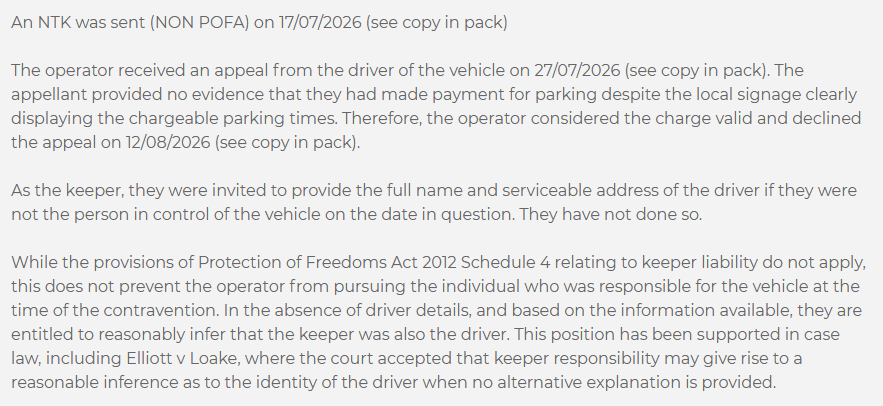
The extract demonstrates an important distinction. If Schedule 4 does not apply, Phoenix Parking Solutions has not transferred the driver's unpaid Parking Charge to the keeper through that statutory mechanism. Phoenix Parking Solutions may still pursue the person it says was driving, but driver identity and contractual liability remain evidential questions.
The wording also deserves close reading. The extract first says Phoenix Parking Solutions received an appeal from the driver, then later relies on the absence of driver details and an inference that the keeper drove. That tension should be addressed directly in an IAS response rather than answered with a generic statement that the notice is non-POFA.
The screenshot does not prove that every IAS case is handled in the same way, nor does an IAS assessment decide a later court claim. It shows why the appellant's capacity, Phoenix Parking Solutions's evidence and every assertion about driver identity must be checked sentence by sentence.
Landowner authority should be treated with the same precision. If Phoenix Parking Solutions does not disclose the underlying authority in the evidence shown to the motorist, identify what is missing and why the material provided does not establish authority to contract, issue Parking Charges or litigate. A broad demand to see a contract is weaker than a specific challenge to the evidence relied upon.
Stage 1: Submit Your Appeal
Start the appeal through the IAS appeal portal. The IAS requires the parking operator to consider the first appeal before it will accept the second-stage appeal. Have the Parking Charge reference, vehicle registration, operator rejection and appellant details ready.
The appeal should state the complete grounds and connect each ground to evidence. Depending on the case, this may include signs, payment records, permits, ANPR images and timestamps, a site plan, lease or tenancy terms, landowner correspondence, medical or breakdown evidence, the Notice to Keeper and the full first-stage correspondence.
Where the driver has not been identified, truthful wording must distinguish between the driver, the keeper and the appellant. Phrases such as "I parked" can identify the appellant as the driver and change the legal issue. Never deny being the driver unless that is true.
The IAS permits a third-party representative, subject to registration and the motorist's consent. Keep the submission confirmation and a complete copy of everything uploaded.
Stage 2: Review Operator Evidence
After the appeal starts, the parking operator uploads a prima facie case. The IAS describes this as enough information or evidence to show, on its face, that the Parking Charge is lawful. That case is still open to rebuttal.
Read every page and attachment. The evidence may contain the Phoenix Parking Solutions Parking Charge Notice, ANPR or attendant images, site photographs, a sign schedule, payment or permit records, an event log, the first appeal, the rejection and a statement about Phoenix Parking Solutions's authority. Compare dates, times, locations, wording and amounts with the original notice and your own records.
Check whether the evidence proves the actual allegation. A photograph of a sign does not establish that the same sign was visible from the vehicle's position on the date. A list of ANPR timestamps does not by itself prove a continuous period of parking. A summary of authority does not answer every dispute about Phoenix Parking Solutions's contractual capacity.
The Private Parking Sector Single Code of Practice is relevant, but the IAS procedure says that a simple code breach is not, by itself, a ground for cancellation. Explain the consequence: for example, why inadequate signs prevented contractual terms from being communicated, why a required consideration or grace period changes the alleged breach, or why missing notice information prevents keeper liability under Schedule 4.
£9.99
Start Your Appeal
Send the Phoenix Parking Solutions Parking Charge Notice and rejection before the IAS deadline. Parking Mate UK identifies Phoenix Parking Solutions, prepares the grounds and evidence, submits the IAS Appeal and keeps the case record together.
Stage 3: Submit Your Response
The IAS portal gives the motorist an opportunity to answer Phoenix Parking Solutions's prima facie case. Its published procedure allocates five working days for party responses and allows the response cycle to repeat until the evidence is complete.
Respond point by point. Identify each disputed statement, quote or describe the relevant operator evidence, state why it is wrong or incomplete and link the answer to a labelled document or photograph. Do not replace a precise rebuttal with a long restatement of the original appeal.
The portal may also offer the option to send the case straight to adjudication. Use that only when Phoenix Parking Solutions's evidence creates nothing that requires an answer. The IAS user guide warns that once the case is sent to adjudication, neither side can add more information.
If an operator submission appears inconsistent with the Sector Single Code, Schedule 4 or its own earlier correspondence, preserve the complete evidence pack and explain the inconsistency in the IAS response. A separate complaint can be made to Phoenix Parking Solutions and then the International Parking Community about code compliance, but a complaint does not replace the appeal response.
Stage 4: IAS Decision
When both sides have finished submitting evidence, the case goes to an adjudicator for a documents-only decision. The current IAS procedure says it seeks to decide appeals within 28 working days after all evidence has been submitted. The decision should explain the grounds on which it is based.
An allowed Standard Appeal requires the parking operator to cancel the Parking Charge. Operator concessions before adjudication also end the appeal in the motorist's favour without a written merits decision.
A dismissed Standard Appeal means the IAS was not persuaded that the Parking Charge was unlawful on the submitted case. It does not create a County Court Judgment and it does not bind the motorist. Phoenix Parking Solutions may seek payment and may later send debt recovery correspondence or a Letter Before Claim before issuing a County Court Claim.
A Non-Standard Appeal has different consequences because its decision binds both the motorist and Phoenix Parking Solutions. Check which procedure was selected before deciding what to do after the result.
After the IAS Decision
Keep the IAS decision, complete evidence pack and response history. If the appeal is allowed or Phoenix Parking Solutions concedes, retain the cancellation evidence in case an automated reminder or debt letter is sent later.
If a Standard Appeal is dismissed, read the adjudicator's reasons carefully. Separate the issues the adjudicator accepted from the issues that failed for lack of evidence or legal relevance. A later County Court Claim is governed by court procedure and the claimant must prove its case there; the court is not conducting an IAS appeal review.
Concerns about operator conduct or code compliance can be raised through Phoenix Parking Solutions's complaint process and then the International Parking Community. A constituent may also ask an MP to record or raise wider concerns about private parking practice. Neither complaint process overturns the IAS decision, determines contractual liability or replaces a County Court Defence.