Parking Mate UK
Mandatory cycle lane appeals
Code 36 PCN Appeal: Being in a Mandatory Cycle Lane
Received a Code 36 PCN for entering a mandatory cycle lane? The solid white boundary, operating times and reason for crossing matter. Parking Mate UK checks the signs, lane layout and full CCTV, then prepares and submits your formal representation.
Start with a free Code 36 assessment. Our £9.99 Automated Penalty Charge Appeal Service includes preparing and submitting your formal representation and tribunal appeal.
Check Your PCN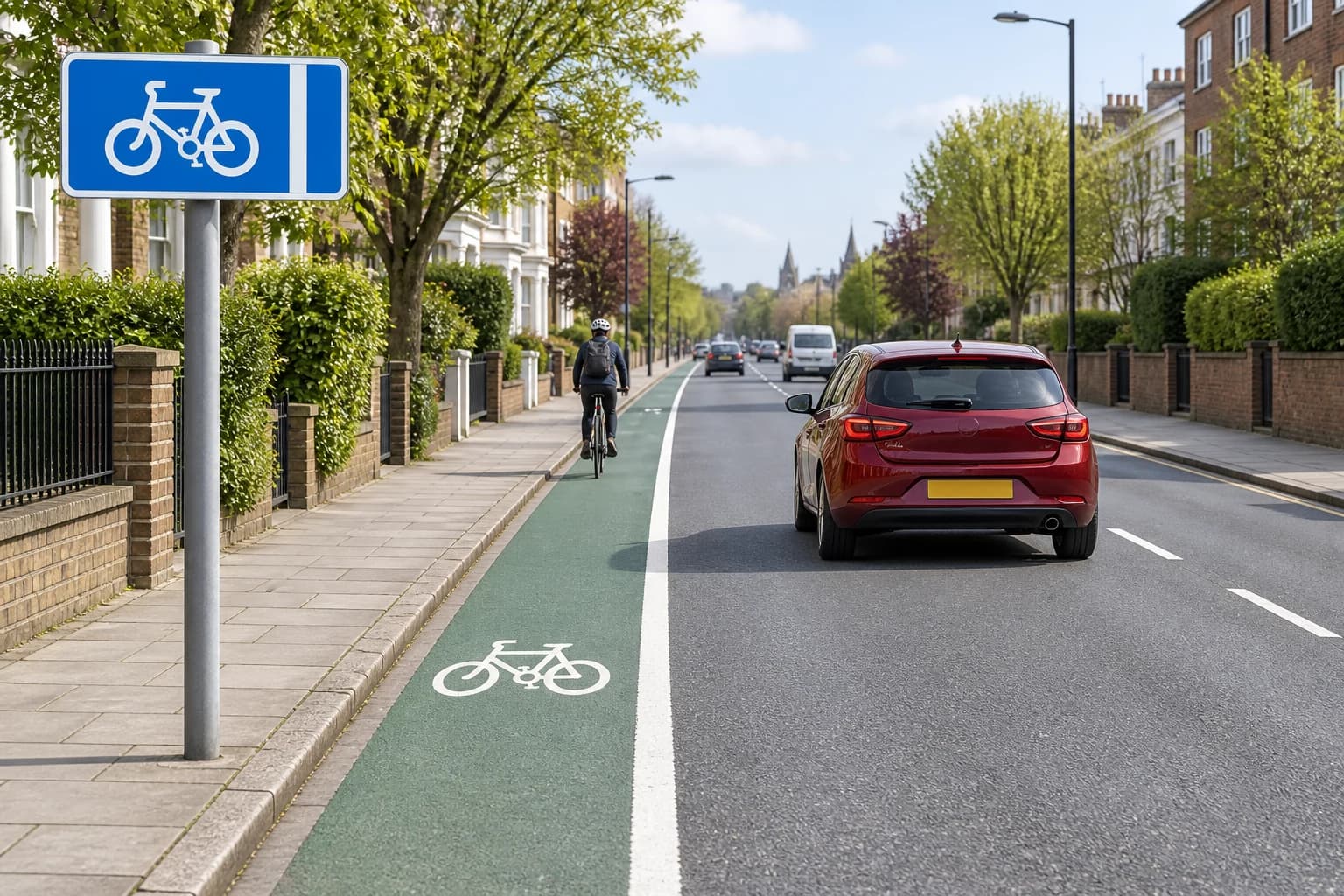
1. What does contravention Code 36 mean?
Code 36 means that your vehicle is alleged to have been in a mandatory cycle lane when it was not entitled to be there. A mandatory lane forms part of the carriageway and is separated from other traffic by a continuous white line. With-flow cyclists travel in the same direction as the adjacent traffic; a contraflow lane carries cyclists against that traffic direction.
An advisory cycle lane has a broken boundary and different rules. A cycle track is physically protected or separate from the motor carriageway. A bicycle symbol or coloured surface alone does not establish which restriction applies. Read the allegation and check the actual layout where the vehicle entered.
For Code 36, a brief entry can matter even if no cyclist was present and the vehicle did not park. The full movement and any applicable exception must still be considered.
- Contravention
- Code 36: being in a mandatory cycle lane
- Lane boundary
- A continuous white line marks a mandatory lane; a broken-line advisory lane is different
- Main evidence
- The boundary at the point of entry, lane signs and hours, complete vehicle movement and any applicable exception
- Penalty amount
- London borough moving-traffic scheme: £160, reduced to £80 during the initial discount period. England outside London: £60 or £70, reduced to £30 or £35, according to the applicable charging band. Follow the notice for other schemes, Wales and the discount deadline.
- Representations
- For a London Code 36 PCN, the authority must receive your representation within 28 days of service of the PCN
- Appeal route
- Formal representations to the issuing authority; after rejection, London Tribunals in London or the Traffic Penalty Tribunal under the relevant schemes elsewhere
2. Which signs and lines identify a mandatory cycle lane?
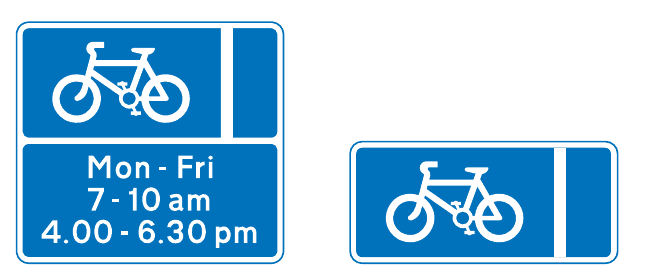
For a mandatory with-flow lane, diagram 959.1 is the blue rectangular sign showing a white bicycle and a vertical white boundary line. The solid road marking is diagram 1049B. Read any operating-time panel; if that panel is omitted, the lane operates at all times.
The advance sign, diagram 958.1, shows a diagonal approach to the lane. It is different from the sign identifying the lane itself. An advisory route sign, diagram 967, shows a bicycle without the mandatory lane's boundary graphic. Circular cycle-route or shared-use signs concern a different arrangement and are not interchangeable with a with-flow lane sign.
Check the precise road section. A mandatory lane may change to a broken-line advisory section at a side road, then resume beyond it. Green or red surfacing is not what creates the restriction. A contraflow layout needs its own one-way and cycle-lane signing.
3. What must the authority prove?
The authority needs to establish the restriction, the vehicle's movement within it and liability for the notice. The sign photographs, boundary and CCTV should relate to the same approach and date.
- Mandatory lane, not another facility: identify the solid boundary and the part of the carriageway reserved for cycles. Distinguish a broken-line section, separate track or cycle waiting area at traffic lights.
- Operating period: compare the CCTV timestamp with the time panel and the legal restriction. A missing time panel on diagram 959.1 normally means continuous operation, not that the restriction is inactive.
- Legal basis: a mandatory with-flow lane can be provided without a traffic order. If the PCN relies on a traffic management order, its operative provisions must cover the lane and movement alleged. A mandatory contraflow lane requires an order.
- Complete movement: examine where the vehicle crossed the boundary and what happened next. A recording ending at the apparent stop may not resolve an explanation that the vehicle was turning into adjacent premises.
- Adequate signs and markings: assess visibility from the approach and the condition of the boundary. Reflectorisation and sign illumination have their own rules; there is no universal requirement for two upright signs or direct lighting on every cycle-lane sign.
- Correct vehicle and person: check the registration and vehicle appearance, owner or hire records and any evidence that the number plate was cloned.
4. Grounds for appealing a Code 36 PCN
Explain the specific problem in the allegation and support it with the recording, photographs or documents. The absence of cyclists, a short stay or a passenger pickup does not by itself establish a ground for cancellation.
- The vehicle was not in the mandatory section: identify its position against the actual solid boundary, including any change to advisory markings at a junction.
- The restriction was not operating: provide the applicable sign times, recorded time and relevant order provision where an order is relied upon.
- The movement was covered by an exception: show why crossing or straddling a with-flow boundary was safe and necessary, and identify the applicable provision. For contraflow lanes, check the operative order's exceptions.
- The evidence is incomplete: specify the missing seconds, approach, sign view or onward manoeuvre needed to test your explanation.
- The signs did not adequately convey the lane restriction: use dated approach photographs and evidence of the relevant boundary, rather than relying only on missing coloured surfacing.
- The PCN concerns a different or cloned vehicle, or you were not the liable owner: provide vehicle differences, police confirmation or the relevant dated ownership and qualifying-hire documents.
5. When can crossing a mandatory cycle lane be permitted?
For a mandatory with-flow lane governed by TSRGD Schedule 9 paragraph 12, crossing into the lane or straddling its boundary can be permitted where it is safe and necessary: to pass a stationary vehicle, enter adjacent land or premises or a joining road from the same side, because of circumstances outside the driver's control, to avoid an accident, or to comply with a uniformed constable's or traffic warden's direction.
These are limited exceptions, not permission to drive along the lane to avoid a queue or wait there while a destination becomes available. A driveway explanation needs the complete manoeuvre and evidence of the destination. Give way to cyclists, including those approaching from behind, before crossing.
The regulations also identify particular emergency-service uses with conditions. A private car making way for an ambulance is not itself an ambulance: explain why the actual movement was necessary and provide the supporting sequence. Where an order is the basis of enforcement, check its own wording rather than assuming an exception applies.
A private-hire licence, passenger pickup, delivery or Blue Badge does not create a general cycle-lane permission. If your circumstances support a request for discretion rather than a legal exception, explain them clearly to the authority.
[2][4][15][9]6. How to make a formal representation
For a London Code 36 PCN, submit formal representations to the issuing authority using the details on the notice. London Tribunals states they must be received "within 28 days of the date the Penalty Charge Notice is served".
Outside London, use the submission route and deadline on the notice under the applicable English or Welsh scheme.
- Open the official evidence and challenge portal shown on the PCN. Enter the notice reference and vehicle registration.
- Review the full CCTV, including the approach and what happened after entry. Identify the solid or broken boundary, the lane sign and any operating times.
- State your ground and explain the exact issue: lane classification, time, permitted crossing, missing footage, vehicle identity or liability. Attach the evidence that addresses it.
- Identify any missing evidence needed to resolve the point, submit the representation by the deadline and keep the full text, attachments and dated acknowledgement.
Will appealing affect the 50% discount?
The 50% reduction is an early-payment discount, not a discount for making an appeal. Check the reduced amount and payment deadline on your PCN before deciding whether to pay or challenge it. The discount deadline and the deadline for representations are not necessarily the same.
An early challenge may give you another opportunity to pay the discounted amount if it is rejected. Check the issuing authority's policy and the terms of its reply; a renewed discount is not automatic for every notice. Submit through the correct challenge route and keep the dated confirmation.
If you take the case to the tribunal, do not assume the discount remains available. An allowed appeal cancels the penalty. If the appeal is refused, the full penalty is normally payable. Read the rejection and tribunal decision for the payment instructions.
7. How long does the authority have to respond?
London Tribunals states that the authority "should normally respond to representations within 3 months".
For formal representations under England's 2022 regulations outside London, the authority must serve its decision within 56 days of receiving them. Welsh Government guidance also states a 56-day response period under the separate Welsh regulations.
[9][11][10][12]8. Check the Notice of Rejection and evidence
The Notice of Rejection should explain the decision and provide tribunal appeal instructions. Check whether it addresses the point you raised: which boundary applied, what the complete recording shows, the exception relied upon or evidence of cloning.
A response saying the vehicle entered the lane may not answer a supported explanation about crossing to premises. Equally, an assertion that the stay was brief does not answer evidence of prohibited entry. Compare the authority's explanation with the full sequence and applicable restriction.
Record the date of service and the appeal deadline. Keep the PCN, your representation, acknowledgement, rejection and attachments together, then check the tribunal evidence pack for anything new.
[9][13][15]9. Taking a Code 36 appeal to the tribunal
For a London PCN, register your appeal with London Tribunals within 28 days beginning with service of the Notice of Rejection. Use its verification details, select the relevant ground and explain how the lane evidence or vehicle records support your case.
Outside London, the Traffic Penalty Tribunal handles the relevant English and Welsh schemes. Use the appeal details in the rejection. Both tribunals are independent and normally charge no appeal fee; if the appeal is refused, the full penalty is normally payable.
Present the lane boundary, signs and full movement in order. For an exception, identify its wording and the evidence meeting its conditions. For cloning, distinguish your vehicle from the recorded one and include the supporting correspondence. Previous decisions illustrate issues but do not replace the evidence in your own case.
[9][13][14][15]Recent Code 36 tribunal decisions
Two allowed appeals concern incomplete CCTV and a cloned vehicle. A refusal explains why a passenger pickup did not establish an exemption. Full case details and authority attribution are available in each commentary.
The CCTV ended before the driveway explanation could be tested
Case 2250194668 / 2025-08-18 / Adjudicator Carl Teper
Carl Teper allowed the appeal because the recording stopped at the point the vehicle appeared to stop. Without the onward sequence, the adjudicator could not test the motorist's explanation that they were manoeuvring into a driveway.
Read the case commentary“Accordingly, I am not satisfied that the Authority has proved this contravention.”
Carl Teper, case 2250194668
Police confirmation supported the cloned-vehicle explanation
Case 2250229161 / 2025-09-04 / Adjudicator Edward Houghton
Edward Houghton allowed the appeal after accepting that the vehicle had been cloned on the balance of probabilities. A police email supported the explanation, and the authority's attempt to discredit it was unconvincing.
Read the case commentary“The Appeal is therefore allowed.”
Edward Houghton, case 2250229161
A private-hire pickup did not create permission to enter the cycle lane
Case 2250413444 / 2025-12-22 / Adjudicator Herjinder Mann
Herjinder Mann refused the appeal after the CCTV showed the vehicle entering and stopping in the cycle lane. The driver's explanation that they were collecting passengers for their safety did not establish an exemption.
Read the case commentary“There is no exemption for private hire drivers to enter cycle lanes.”
Herjinder Mann, case 2250413444
2025 London Tribunals Code 36 results
2 of 7 recorded cases were allowed (28.6%).
| Recorded outcome | Cases |
|---|---|
| Allowed | 2 |
| Refused | 5 |
| Total | 7 |
Sources and references
- Standard contravention codes
Linked code list, page 2: Code 36, being in a mandatory cycle lane, suffix j.
- TSRGD 2016, Schedule 9
Part 4 item 9 (959.1), Part 6 item 7 (1049B), Part 7 paragraph 12, Part 8 paragraphs 1 and 9, Part 9 direction 1(2). Supplied PDF pages 144, 150, 168-170 and 173; regulation 8, page 11.
- Traffic Signs Manual, Chapter 3 (2019)
Sections 11.1, 11.3-11.6 and 11.11: carriageway lanes versus tracks, mandatory versus advisory, signs, boundary markings, with-flow and contraflow. Figure 11-4: PDF page 123, printed page 121.
- Highway Code: Rule 140
Rule 140: solid and broken cycle-lane boundaries, cycle tracks and yielding to cyclists when crossing.
- Know Your Traffic Signs: bus and cycle signs
Cycle signs section: mandatory with-flow, advisory and contraflow lane signs, markings and cycle-track signs.
- TSRGD 2016, Schedule 11
Part 2 items 38 and 44 (958.1 advance and 967 advisory signs); Part 4 boundary/lead-in and cycle-symbol markings. Read with TSM 11.3-11.4.
- Local Authorities' Traffic Orders Regulations 1996
Regulation 18: information about the effect of an order and maintenance of signs where an order applies.
- London Local Authorities and Transport for London Act 2003
Section 4 and Schedule 1: applicable enforcement basis, owner liability, representations and appeals. Check the actual prescribed order or scheduled-sign route, not the code number alone.
- London Tribunals: moving-traffic PCN enforcement
Representations received within 28 days of PCN service; normal three-month response expectation; tribunal appeal within 28 days of rejection service.
- DfT: moving-traffic enforcement outside London
English 2022 scheme; representations and 56-day decision service period.
- England's 2022 Representations and Appeals Regulations
Regulation 6: decision served within 56 days for qualifying formal representations; not London's 2003 Act procedure.
- Welsh Government: moving-traffic enforcement guidance
Paragraphs 92-93: 28-day representations and 56-day response under the separate Welsh regulations.
- London Tribunals: preparing your appeal
Evidence and statutory grounds for the independent appeal.
- Traffic Penalty Tribunal: moving-traffic PCNs
Relevant appeal schemes outside London.
- London Tribunals: registers of appeals
Search the linked references. Statistics use the supplied archive, 2025 decision dates and exact 'Being in a mandatory cycle lane' label; all seven full reasons reviewed.
- London Councils: parking and traffic charges
Borough minor moving-traffic charge £160, reduced by 50% for qualifying early payment. Not a universal charge for every London scheme.
- England's 2022 charging guidelines
Schedule 3 paragraphs 1-2: higher-level moving-traffic bands £60 or £70 and their 50% discounted amounts. Apply the relevant charging scheme.
About Parking Mate UK
We assess real Code 36 decisions to identify the evidence that matters: the type of cycle facility, the solid boundary, operating times, the complete movement and vehicle identity.
Our 2025 mandatory-cycle-lane analysis covers 7 London Tribunals decisions: 2 allowed and 5 refused. The allowed cases show why a missing part of the recording or supported cloning evidence can matter; neither was a finding that all cycle-lane signs were defective.
Send your Code 36 PCN for a free assessment. Parking Mate UK prepares and submits your formal representation and handles your tribunal appeal, with support online and on WhatsApp.
Check Your PCN