Parking Mate UK
No-entry sign and wrong-way entry appeals
Code 51 PCN Appeal: How to Challenge a No-Entry Sign PCN
Received a Code 51 PCN after passing a no-entry sign? The red sign, any exception plate, your direction of travel and the point where you could see the restriction matter. Parking Mate UK checks the CCTV, approach signs and legal restriction, then prepares and submits your formal representation.
Start with a free Code 51 assessment. Our £9.99 Automated Penalty Charge Appeal Service includes preparing and submitting your formal representation and tribunal appeal.
Check Your PCN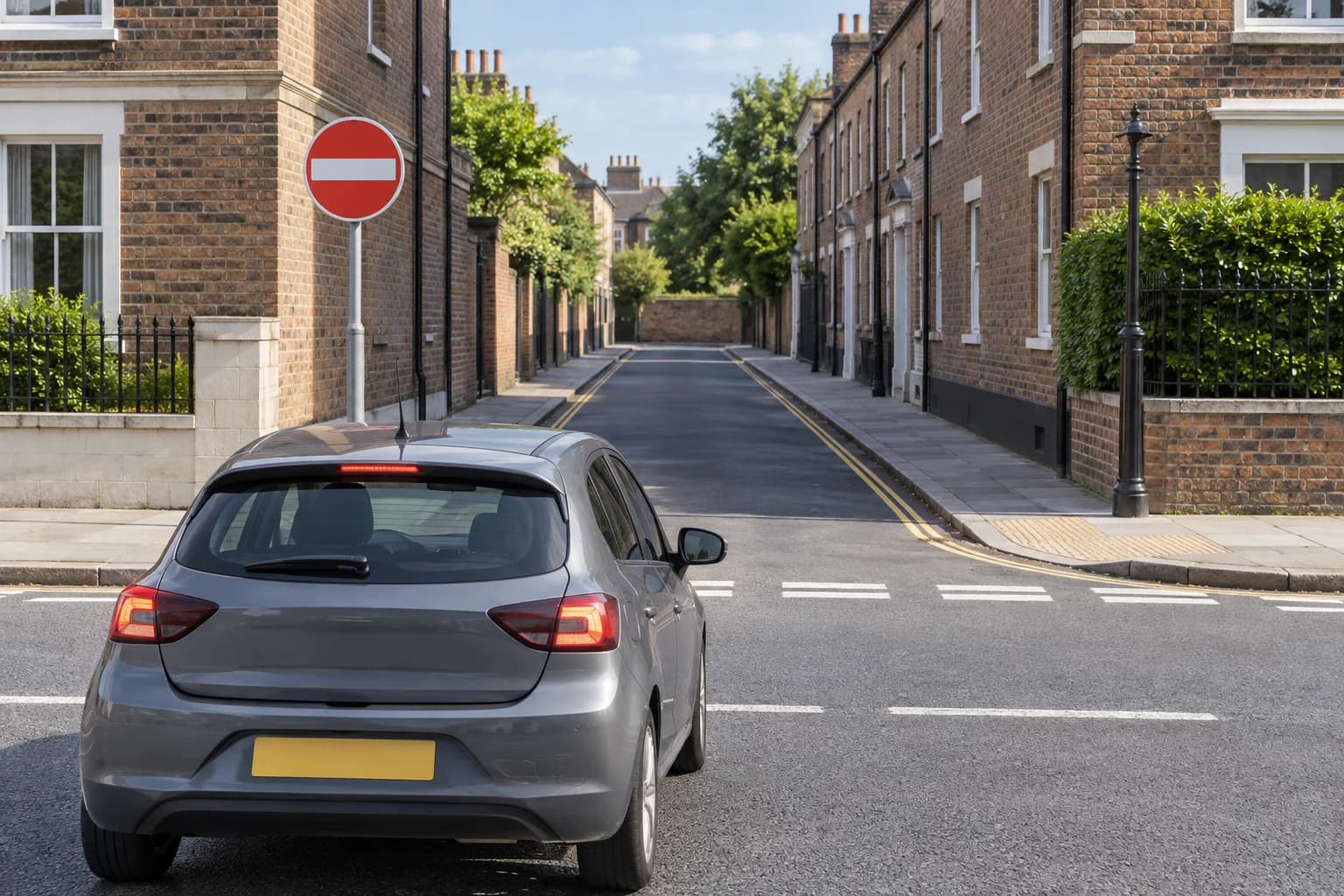
1. What does contravention Code 51 mean?
Code 51 means that your vehicle is alleged to have passed a no-entry sign from the prohibited direction. It commonly concerns entering the exit of a one-way road, but no-entry signs can also restrict an individual junction or a route admitting only the vehicles identified on an exception plate.
The allegation is about passing the sign, not parking or causing an obstruction. An empty road or a short journey beyond the sign does not itself answer it. Check the complete description on the PCN: a no-entry sign is different from a no-motor-vehicles sign or a separate allegation of driving against a one-way instruction.
This guide covers a civil Penalty Charge Notice. The authority must have the relevant enforcement powers for the restriction and area; a police notice follows a different process.
- Contravention
- Code 51: failing to comply with a no entry sign
- Typical restrictions
- Entry against a one-way system, prohibited entry at a junction, or a no-entry restriction with a permitted-vehicle exception
- Main evidence
- CCTV showing the entry, the red sign facing that approach, any exception plate and the operative restriction
- Penalty amount
- London: £160, reduced to £80 during the initial discount period. England outside London: £60 or £70, reduced to £30 or £35, according to the applicable charging band. Follow the notice for Wales and the discount deadline.
- Representations
- For a London Code 51 PCN, the authority must receive your representation within 28 days of service of the PCN
- Appeal route
- Formal representations to the issuing authority; after rejection, London Tribunals in London or the Traffic Penalty Tribunal under the relevant schemes elsewhere
2. Which sign applies to a Code 51 PCN?
The no-entry sign is a red circular disc with a horizontal white bar: diagram 616, TSRGD Schedule 3 Part 2 item 10. It means no entry for vehicular traffic from the direction facing the sign. A red ring containing a motorcycle and car is a different restriction.
A supplementary plate can identify an exception for cycles, buses, local buses, buses and cycles, local buses and cycles, or trams. Read the actual plate rather than assuming that an exception at another entrance applies here.
The NO ENTRY road marking can supplement the upright sign. Its absence does not, by itself, invalidate a properly signed no-entry restriction. The signs should make clear which entrance is prohibited before the driver commits to it.

3. What must the authority establish?
The evidence needs to connect your vehicle, its direction of travel and the sign at the prohibited entry point. A photograph showing the back of a sign or a different approach cannot, on its own, show what the driver could see.
- The restriction applied: check the operative order, map or other legal basis against the road, direction and date. Temporary restrictions need evidence of when and where they operated. Older signs may have a saved legal basis which also needs checking.
- The sign faced the relevant approach: compare the CCTV with dated photographs showing its position, orientation and any exception plate. Signs indicating the start of a restriction must be as near as practicable to that point.
- The entrance was adequately signed: check visibility before the turn, obstruction by vehicles or street furniture, and confusing combinations of road-closure and directional signs. There is no universal requirement for two no-entry signs.
- Night-time requirements were met: direct lighting depends on the road speed, proximity to street lighting and the conditions in TSRGD. Temporary roadworks signs and bollard-mounted signs need their own checks; an unlit sign is not automatically defective.
- The prohibited movement occurred: the full recording should establish that the identified vehicle passed the sign in the prohibited direction. Being filmed elsewhere on the road is not the same evidence as the entry itself.
- The correct person is liable: check ownership, any qualifying hire arrangement and the notice history under the applicable enforcement scheme.
4. Grounds for appealing a Code 51 PCN
Build the representation around the evidence that is wrong, missing or inconsistent. A missed sign and a sign that could not adequately be seen are different arguments.
- The vehicle did not make the alleged entry: identify the route actually taken, any gap in the recording or a registration mismatch.
- The sign was obscured or misleading on your approach: show the driver's view before the entry, including roadworks, competing instructions and the last available alternative route.
- The restriction did not cover this movement: point to the relevant order schedule, map, direction, commencement or temporary operating conditions.
- A genuine exception applied: provide the applicable provision, vehicle classification and evidence that its conditions were satisfied.
- There is a liability or notice problem: supply dated ownership or qualifying hire documents, or identify the precise defect under the applicable scheme.
- The handling of your representation was unfair: retain submission and response dates, acknowledgements and the explanation for delay. A London response beyond three months is not an automatic statutory cancellation.
5. Exceptions, access and mitigation
An 'Except cycles' plate does not permit a car to enter. Similarly, a bus exception does not become a taxi, private-hire or residents' exception. Match the vehicle to the sign and the applicable legal provision.
A delivery, nearby home, Blue Badge, passenger drop-off or satnav instruction does not itself authorise entry. If you rely on police directions, emergency use or another legal exception, identify the provision and provide evidence of the circumstances and its conditions.
Roadworks do not automatically authorise a prohibited entry. Where barriers and signs appeared to direct you into the restriction, show the complete layout and the point at which another route could have been chosen. Reversing through the entry is not a general exemption either.
The authority can consider mitigation even where no legal ground applies. Explain the circumstances and ask for discretion, but keep that request separate from an evidence-based ground: the London adjudicator cannot cancel a PCN solely because the circumstances are sympathetic.
[2][4][9][15]6. How to make a formal representation
For a London Code 51 PCN, submit formal representations to the issuing authority using the details on the notice. London Tribunals states they must be received "within 28 days of the date the Penalty Charge Notice is served".
Outside London, use the submission route and deadline on the notice under the applicable English or Welsh scheme.
- Open the official evidence and challenge portal shown on the PCN. Enter the notice reference and vehicle registration.
- Watch the complete CCTV and record the approach, entry point, direction and time. Obtain dated photographs of the no-entry sign and any exception plate facing that approach.
- State your ground and explain the specific issue: disputed entry, obscured or confusing signs, restriction extent, an applicable exception or liability. Attach the photographs, route plan and documents that support it.
- Identify any missing evidence needed to resolve the point, submit the representation by the deadline and keep the full text, attachments and dated acknowledgement.
Will appealing affect the 50% discount?
The 50% reduction is an early-payment discount, not a discount for making an appeal. Check the reduced amount and payment deadline on your PCN before deciding whether to pay or challenge it. The discount deadline and the deadline for representations are not necessarily the same.
An early challenge may give you another opportunity to pay the discounted amount if it is rejected. Check the issuing authority's policy and the terms of its reply; a renewed discount is not automatic for every notice. Submit through the correct challenge route and keep the dated confirmation.
If you take the case to the tribunal, do not assume the discount remains available. An allowed appeal cancels the penalty. If the appeal is refused, the full penalty is normally payable. Read the rejection and tribunal decision for the payment instructions.
7. How long does the authority have to respond?
London Tribunals states that the authority "should normally respond to representations within 3 months".
For formal representations under England's 2022 regulations outside London, the authority must serve its decision within 56 days of receiving them. Welsh Government guidance also states a 56-day response period under the separate Welsh regulations.
[9][11][12]8. Check the Notice of Rejection and evidence
The Notice of Rejection should explain why the authority has rejected your representation and provide the tribunal appeal instructions. Check whether it addresses the actual dispute: which sign faced you, where it became visible, what the CCTV shows and why an exception does not apply.
For roadworks or a changed layout, compare the dates and positions of the photographs with the recording. A clear sign photographed on a different day does not resolve an allegation that it was obscured at the time. For a disputed order, identify the exact map, article or temporary restriction condition still in issue.
Record the date of service and the appeal deadline. Keep the PCN, your representation, acknowledgement, rejection and evidence together. If response delay is relevant, preserve the complete correspondence chronology and any explanation provided.
[9][13][15]9. Taking a Code 51 appeal to the tribunal
For a London PCN, register your appeal with London Tribunals within 28 days beginning with service of the Notice of Rejection. Use its verification details, select the relevant ground and explain how the sign, entry recording or applicable exception supports your case.
Outside London, the Traffic Penalty Tribunal handles the relevant English and Welsh schemes. Use the appeal details in the rejection. Both tribunals are independent and normally charge no appeal fee; if the appeal is refused, the full penalty is normally payable.
Arrange the evidence in the order the driver encountered it: approach, competing signs, decision point and prohibited entry. Respond to the authority's evidence pack and distinguish a legal ground from a request for discretion. Previous decisions illustrate how particular evidence was assessed; they do not decide a different journey automatically.
[9][13][14]Recent Code 51 tribunal decisions
Two allowed appeals and one refusal distinguish confusing approach signs, unfair response delay and a restriction proved by the evidence. Full case details and authority attribution are available in each commentary.
An obscured first sign and a late second sign did not give adequate warning
Case 2250440356 / 2025-12-23 / Adjudicator Sean Stanton-Dunne
Sean Stanton-Dunne allowed the appeal after finding that the first no-entry sign was obscured and the second was too far into the restricted route. Road-closure and directional signs added to the confusion.
Read the case commentary“The signage and markings are, in my judgement, confusing to the motorist.”
Sean Stanton-Dunne, case 2250440356
The entry was proved, but an unfair response delay made enforcement unsustainable
Case 2250361271 / 2025-12-24 / Adjudicator Richard Young
Richard Young allowed the appeal on procedural fairness grounds despite finding the no-entry restriction clear and the movement proved. The delay and absence of a holding response were central to the decision.
Read the case commentary“I find that, on the particular facts of this case, that the delay in responding to the formal representations is procedurally unfair.”
Richard Young, case 2250361271
The recording and signs established the temporary no-entry restriction
Case 2250438365 / 2025-12-31 / Adjudicator Lola Moses
Lola Moses refused the appeal after accepting that the CCTV, sign photographs and temporary order established the restriction. No applicable vehicle exception was demonstrated.
Read the case commentary“On the evidence, I am satisfied that the restriction was so indicated by the signs at the location and that the signage was adequate for a reasonably diligent motorist.”
Lola Moses, case 2250438365
2025 London Tribunals Code 51 results
102 of 378 recorded cases were allowed (27.0%).
| Recorded outcome | Cases |
|---|---|
| Allowed | 102 |
| Refused | 276 |
| Total | 378 |
Sources and references
- Standard contravention codes
Linked standard code list, Code 51: failing to comply with a no entry restriction. Exact research cohort wording is retained separately.
- TSRGD 2016, Schedule 3
Part 2 item 10, diagram 616; Part 3 paragraph 11; Part 4 paragraphs 1, 2, 4 and 9 as amended in 2017; Part 5 directions 1 and 2. Supplied PDF pages 70 and 77-80; read original table with the 2017 amendment.
- Traffic Signs Amendment Regulations 2017
Regulation 6(2)(b) and (3): item 10 column 6 becomes 1, 2, 4, 9; section 36 designation and added paragraph 9. In force 13 December 2017 in England and Wales.
- Traffic Signs Manual, Chapter 3 (2019)
Paragraphs 4.9.5-4.9.9 and 4.10.1-4.10.4: no-entry sign siting, single signs, optional markings, exceptions, bollards and older approvals. Supplied PDF pages 41-43.
- TSRGD 2016, Schedule 9
Part 6 item 17, diagram 1046 NO ENTRY marking; TSM 4.9.7 explains its supplementary use.
- Local Authorities' Traffic Orders Regulations 1996
Regulation 18: information about the effect of an order and maintenance of signs, where the Regulations apply.
- London Local Authorities and Transport for London Act 2003
Section 4, Schedule 1 and amended Schedule 3: prescribed orders, scheduled section 36 signs, owner liability, representations and appeals.
- Civil Enforcement Consequential Amendments 2018
Regulations 3-4: diagram 616 in TMA Schedule 7 and London Act Schedule 3. The TMA table qualifies no-entry enforcement by whether another civil-enforceable sign may indicate the restriction; do not transplant that qualifier into London's table.
- London Tribunals: moving-traffic PCN enforcement
Formal representation receipt within 28 days of PCN service, normal three-month response expectation and 28-day appeal after rejection service. Three months is not an automatic statutory cancellation rule.
- DfT: moving-traffic enforcement outside London
English moving-traffic designation, representations and appeals under the 2022 scheme.
- England's 2022 Representations and Appeals Regulations
Regulation 6(3): decision served within 56 days of formal representation service. Also confirmed by DfT's statutory guidance; not London's 2003 Act procedure.
- Welsh Government: moving-traffic enforcement guidance
Paragraphs 92-93: 28-day representation and 56-day response periods under the separate Welsh regulations.
- London Tribunals: preparing your appeal
Evidence and preparation for an independent appeal.
- Traffic Penalty Tribunal: moving-traffic PCNs
Independent appeals in the relevant English and Welsh schemes outside London.
- London Tribunals: registers of appeals
Search the selected case references. Counts use the supplied 2025 archive and exact no-entry label, deduplicated by case reference.
- London-wide parking and traffic charges
Minor moving-traffic charge £160 and applicable 50% early-payment reduction; follow the particular notice's discount deadline.
- England's 2022 charging guidelines
Schedule 3 paragraphs 1-2: higher-level moving-traffic bands £60 or £70, with 50% discounted amounts. Use the applicable charging band, not a London default.
About Parking Mate UK
We assess real Code 51 decisions to identify what matters in a no-entry appeal: the sign facing the driver, the opportunity to see it before entering, the vehicle's movement and the applicable restriction.
Our 2025 no-entry analysis covers 378 London Tribunals decisions: 102 allowed and 276 refused. The decisions help distinguish a confusing or obscured sign from a restriction that was adequately signed, and a substantive defence from a request for discretion.
Send your Code 51 PCN for a free assessment. Parking Mate UK prepares and submits your formal representation and handles your tribunal appeal, with support online and on WhatsApp.
Check Your PCN