Parking Mate UK
Bus lane PCN appeals
Code 34 PCN Appeal: How to Challenge a Bus Lane Fine
Received a Code 34 PCN for being in a bus lane? Check whether the lane was operating, your vehicle was permitted and the CCTV shows where you crossed its boundary. Parking Mate UK checks the signs, footage and traffic order, then prepares and submits your formal representation.
Start with a free Code 34 assessment. Our £9.99 Automated Penalty Charge Appeal Service includes preparing and submitting your formal representation and tribunal appeal.
Check Your PCN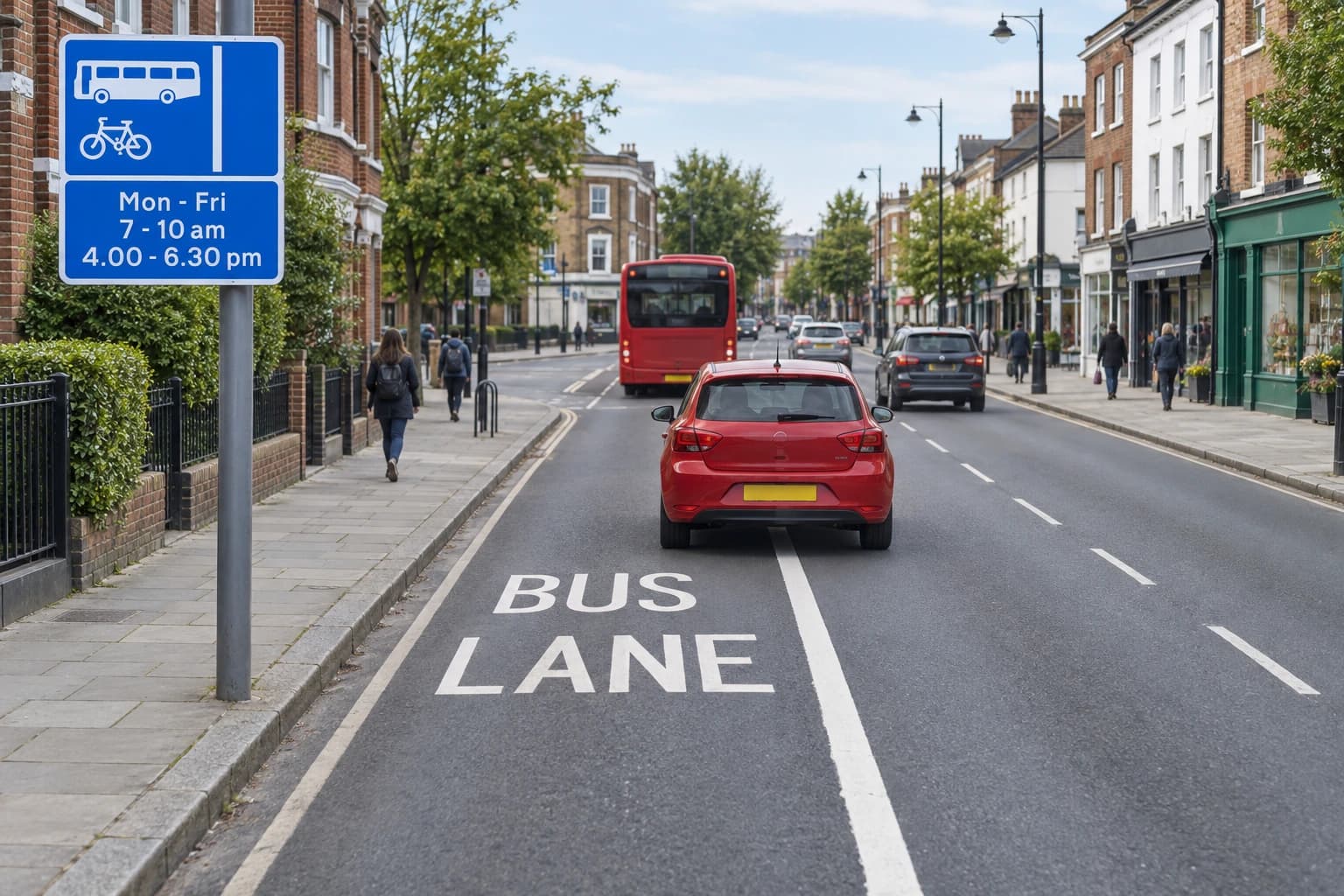
1. What does contravention Code 34 mean?
Code 34 means that a vehicle is alleged to have been in a bus lane when it was not permitted to use it. A with-flow bus lane runs in the same direction as adjacent traffic, usually along the left side of the road. Its vehicle permissions, operating hours and extent depend on the signs and traffic order.
This is lane enforcement, not the Code 33 allegation of using a restricted route or bus gate. The authority does not have to show that a bus was obstructed. Check the full recording: the relevant issue may be entering too early before a left turn, crossing to an access, or driving along the lane.
- Contravention
- Code 34: being in a bus lane
- Main checks
- Operating hours, permitted vehicle class, approach signs, lane boundary and the movement recorded
- Penalty amount
- London: £160, reduced to £80 during the initial discount period. England outside London: £60 or £70, reduced to £30 or £35, according to the applicable charging band. Follow the notice for Wales and the discount deadline.
- London discount
- The initial discount runs for 14 days beginning with the date of the PCN. An initial challenge does not automatically preserve it.
- London representations
- Formal representations follow the Enforcement Notice: 28 days beginning with its service
- Appeal route
- After formal rejection: London Tribunals in London; the Traffic Penalty Tribunal under the relevant English and Welsh schemes
2. Which bus-lane signs and markings matter?
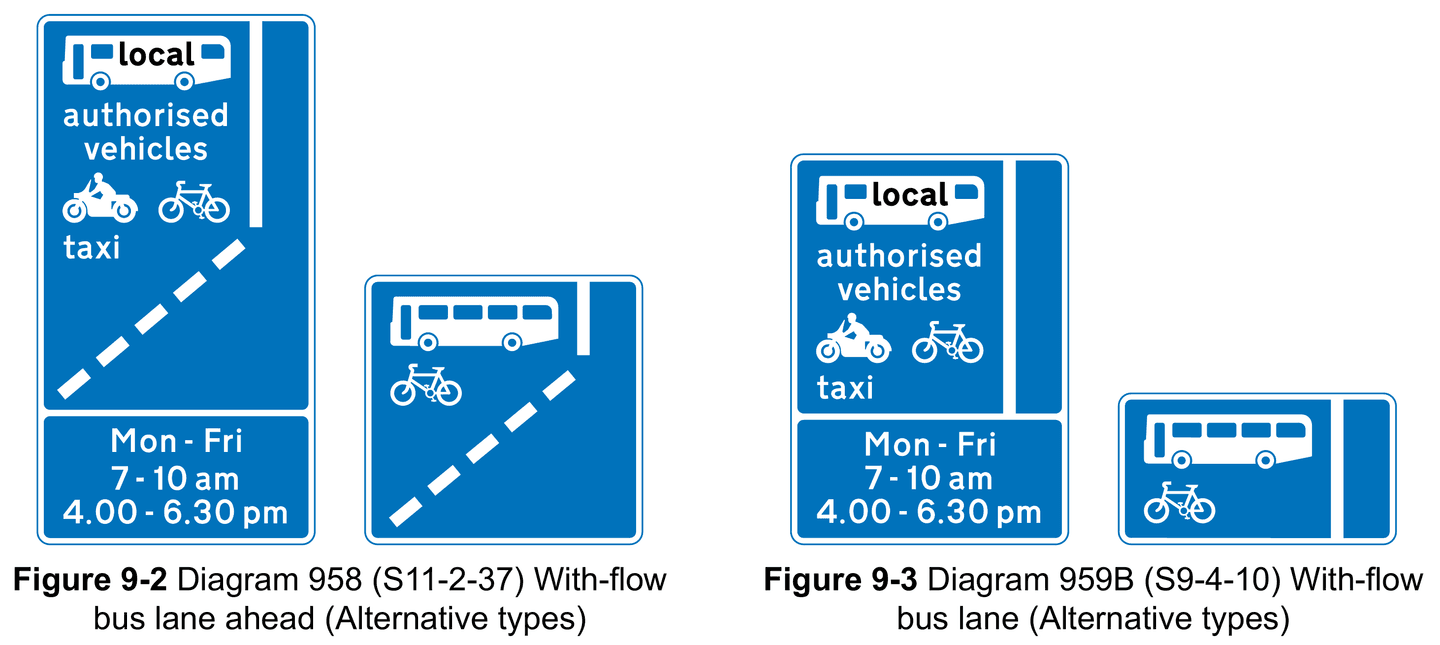
Diagram 958 is the blue advance sign showing the bus lane ahead, including its broken lead-in line. Diagram 959B is the blue rectangular sign at the lane, with a solid white lane divider. Read the actual symbols and wording: buses or local buses, cycles, and any permitted taxis, motorcycles or authorised vehicles.
A time panel shows when the with-flow restriction operates. With no time panel, the sign indicates a lane operating at all times. The sign must match the order; do not assume that permission for motorcycles or taxis in one lane applies in another.
The broad continuous white boundary is diagram 1049A. Broken diagram 1010 markings identify the lead-in or a relevant break, while BUS LANE lettering helps identify the lane. Check where these markings start and end relative to the vehicle. Coloured surfacing is not a legal requirement, and a missing optional End of bus lane sign is not itself proof that the restriction ended earlier.
3. What must the authority establish?
The order, sign evidence and recording need to identify the same lane, direction, operating period and vehicle. A clear image of a car near a bus lane does not resolve where it entered, whether a permission applied or what signs faced its approach.
- An operative traffic order: obtain the article, schedule or map defining the bus lane, its hours, vehicle classes and exceptions, together with relevant amendments.
- An adequately signed approach: check the advance sign and lane sign actually available on the route taken, including after a side-road entry. The manual recommends placing 959B near the start of the continuous line and repeating it after side junctions; its layout guidance is not a universal two-sign requirement.
- A visible lane boundary: compare the continuous line, lead-in, junction break and lane end with the exact vehicle path. Photograph missing or badly worn stretches in context, not only a close-up of one defect.
- Readable signs at the time: identify obstruction by other signs, foliage or vehicles, and unreadable operating hours. The relevant upright signs may be illuminated or reflectorised; absence of a dedicated lamp alone does not establish a defect.
- Reliable camera evidence: the complete recording must identify the vehicle, time and lane use. In London, the recording's admissibility also depends on the 1996 Act's device-approval and evidence requirements.
- The correct liable person and notice: check ownership at the material time, the allegation and the applicable notice and service requirements.
4. Specific grounds for appealing a Code 34 PCN
Tie the challenge to an identifiable problem in the evidence. There is no universal distance allowance that makes the first 20 metres of bus-lane use lawful.
- Outside operating hours: compare the CCTV timestamp and day with the sign panel and the operative order. Include a readable photograph of the complete sign.
- Your vehicle was permitted: provide the vehicle classification, licence or authorisation and identify the matching sign symbol and order definition. A private-hire licence does not automatically establish a taxi exemption.
- The approach was not adequately signed: show the obstruction or missing sign sequence from the driver's route. A photograph of an unobstructed sign elsewhere does not answer that particular issue.
- Access rather than travelling along the lane: identify the destination, the precise crossing and the order provision allowing it. A lawful parking bay may be relevant, but its existence does not automatically justify driving along the bus lane.
- The recording does not establish the alleged lane use: identify the lane end or break, wrong vehicle, incorrect timestamp or missing part of the journey. Explain why the gap changes the allegation.
- A necessary manoeuvre was exempt: provide footage or other evidence of the hazard, police direction or other event and the applicable exception. Simply describing another vehicle as dangerous may not overcome contrary CCTV.
- London camera evidence is not established: identify the particular approval, certification or evidential gap in the authority's material. Do not assume all bus-lane cameras are unapproved.
- Liability is wrong: provide dated sale, purchase or keeper evidence, or evidence that the vehicle was used without consent. Where police action concerns the same conduct, supply the relevant notice.
5. Permitted vehicles and access exceptions
Read the sign and the order together. A local-bus restriction is not permission for every vehicle with several seats. Motorcycle use depends on the lane's permission. Taxi wording does not automatically include private-hire vehicles, and any authorised-vehicle permission must cover the vehicle, lane and date.
Check the exact wording of any access, loading, crossing or emergency exception. A delivery, Blue Badge or destination beside the lane does not by itself establish permission to travel along it. Parking and loading controls are separate from the bus-lane restriction.
For a claimed access exemption, show where the vehicle crossed, the shortest practical movement to its destination and why the order covers that manoeuvre. The selected allowed access case turned on its particular order and a short approach to a lawful parking bay.
Turning left, following satnav or finding the lane empty is not an exemption on its own. If the circumstances support discretion rather than a legal ground, explain them to the authority and provide the evidence.
[2][4][6][15]6. Initial challenge and formal representations
London bus-lane PCNs use the London Local Authorities Act 1996 process. The initial PCN allows 28 days beginning with its date for payment, with the discounted amount available during the first 14 days. Some authorities consider an initial informal challenge; check the notice because this is not the formal representation stage and does not automatically hold the discount.
If the London PCN remains unpaid after that 28-day period, the authority may serve an Enforcement Notice. London Tribunals gives "28 days, beginning with the date of service of that notice" to make formal representations.
In England outside London under the 2022 scheme, formal representations are made against the postal PCN within 28 days beginning with service. Wales has a separate scheme with representations against the PCN within 28 days of service. Use the route and deadline on the relevant notice.
- Review the full CCTV and save the PCN, any Enforcement Notice and the dates received.
- Identify the specific dispute: hours, vehicle permission, sign visibility, lane boundary, access exception, camera evidence or liability.
- Attach dated approach photographs, the relevant footage, authorisation or ownership documents. For an order-based argument, identify the article and schedule or request the missing provision.
- Submit at the correct stage by the applicable deadline. Keep your full submission, attachments and dated acknowledgement.
Will appealing affect the 50% discount?
The 50% reduction is an early-payment discount, not a discount for making an appeal. Check the reduced amount and payment deadline on your PCN before deciding whether to pay or challenge it. The discount deadline and the deadline for representations are not necessarily the same.
An early challenge may give you another opportunity to pay the discounted amount if it is rejected. Check the issuing authority's policy and the terms of its reply; a renewed discount is not automatic for every notice. Submit through the correct challenge route and keep the dated confirmation.
If you take the case to the tribunal, do not assume the discount remains available. An allowed appeal cancels the penalty. If the appeal is refused, the full penalty is normally payable. Read the rejection and tribunal decision for the payment instructions.
7. How long does a response take?
For formal London bus-lane representations, London Tribunals says the authority "should normally respond to representations within 3 months".
For formal representations under England's 2022 scheme outside London, the decision must be served within 56 days of receipt. Welsh guidance gives a 56-day period under its separate regulations.
[8][10][11]8. Check the formal Notice of Rejection
A refusal of an initial London challenge is not the formal Notice of Rejection that opens the tribunal route. After formal representations against the Enforcement Notice, the authority must consider the case and send its decision.
Check whether the rejection answers your actual point: the obscured approach sign, the hours shown, the permitted vehicle, the exact lane entry or the access article. Compare its photographs and order extracts with the CCTV, rather than accepting a general statement that the lane is signed.
For London, you have 28 days beginning with service of the formal Notice of Rejection to pay or appeal. Keep the appeal instructions and verification details with your notices, representations and evidence.
[8][6][15]9. Taking a Code 34 appeal to the tribunal
Register a London bus-lane appeal with London Tribunals within 28 days beginning with service of the Notice of Rejection. Identify the relevant ground and explain how the order, sign evidence or recording supports it. The adjudicator cannot allow a London bus-lane appeal solely because of mitigation.
The Traffic Penalty Tribunal deals with the relevant bus-lane schemes in England outside London and Wales. Follow the formal rejection's appeal instructions and deadline. There is normally no tribunal appeal fee, but an unsuccessful appeal normally leaves the full penalty payable.
Organise the evidence around the disputed movement: approach signs, operating hours, continuous line or break, and the destination or exception relied on. Address the authority's evidence pack directly. The linked cases illustrate different outcomes; a previous decision does not establish that every PCN at a location is invalid.
[8][12][15]Recent Code 34 tribunal decisions
Two allowed appeals and one refusal show why an obscured sign, a specific access exception and entering too early before a left turn require different evidence. Full authority, location and adjudicator details appear in the linked commentaries.
An obscured bus-lane sign and missing approach evidence led to cancellation
Case 2250542731 / 2025-12-20 / Adjudicator Belinda Pearce
Belinda Pearce allowed the appeal after finding that a large directional sign obscured the bus-lane sign and that the authority had not established the preceding signage.
Read the case commentary“I am not satisfied as to the clarity of the sign at the location.”
Belinda Pearce, case 2250542731
The order permitted a short bus-lane approach to a lawful parking bay
Case 2250466994 / 2025-12-02 / Adjudicator Edward Houghton
Edward Houghton allowed the appeal because the particular traffic order exempted the short movement needed to reach a lawful parking bay. This was not a general permission to drive along a bus lane before parking.
Read the case commentary“On the facts I am satisfied exemption applied and that as it transpires the PCN was incorrectly issued.”
Edward Houghton, case 2250466994
Entering too early before a left turn remained a bus-lane contravention
Case 225042265A / 2025-12-27 / Adjudicator Carl Teper
Carl Teper refused the appeal because the CCTV showed an early entry into the bus lane. Turning left and not obstructing a bus did not establish an exemption.
Read the case commentary“I find that they entered the bus lane too soon to turn left”
Carl Teper, case 225042265A
2025 London Tribunals bus-lane results
308 of 879 recorded cases were allowed (35.0%).
| Recorded outcome | Cases |
|---|---|
| Allowed | 308 |
| Refused | 571 |
| Total | 879 |
Sources and references
- Standard contravention codes
Linked 2025 contravention code list: Code 34, Being in a bus lane.
- TSRGD 2016: regulatory bus-lane signs and markings
Schedule 9 Part 4 items 8, 10 and 11 (960, 959B, 964); Part 6 items 11 and 14 (1049A, 1048); assigned Part 8 provisions and Part 9 direction 1. Regulation 8 for upright illumination/reflectorisation.
- TSRGD 2016: advance bus-lane sign and broken marking
Part 2 item 37 (958), permitted variants 10, 11, 13, 14; Part 4 item 10 (1010), variant 41 and Part 6 requirements 7, 8, 11, 12.
- Traffic Signs Manual, Chapter 3 (2019)
Sections 9.1-9.4; particularly 9.1.5, 9.2, 9.3.2-9.3.9 and 9.3.13. Figures 9-2 and 9-3 on printed page 92, PDF page 94, provide the inline official artwork.
- Local Authorities' Traffic Orders Regulations 1996
Regulation 18: adequate information about an order's effect and maintenance of signs.
- London Local Authorities Act 1996: bus lanes
Part II sections 3-6 and 9; Schedule 1. Original Act PDF; read with amendments and the current London Tribunals bus-lane process, not the 2003 moving-traffic procedure.
- London Tribunals: bus-lane camera evidence requirements
Key decision explaining the prescribed-device issue and 1996 Act Schedule 1 paragraph 7 approval, certification and admissibility requirements; case-specific evidence still required.
- London Tribunals: bus-lane PCN enforcement
Initial PCN and informal challenge; Enforcement Notice; formal representations within 28 days of its service; normal three-month response expectation; formal rejection and appeal.
- DfT: bus-lane enforcement outside London
English 2022 scheme: postal PCN, formal representations and decisions. Not the London 1996 Act route.
- England's 2022 Representations and Appeals Regulations
Regulation 6: decision served within 56 days of service of qualifying representations; regulation 5 and Part 3 for representations and appeals.
- Welsh Government: bus-lane and moving-traffic enforcement guidance
Paragraphs 92-93: formal representations within 28 days of PCN service and decision within 56 days under the separate Welsh scheme.
- Traffic Penalty Tribunal: bus-lane PCN and appeal process
Independent appeal after formal rejection under the applicable English/Welsh scheme; full penalty ordinarily payable after refusal. Statutory service-based deadlines take priority over simplified issue-date wording.
- London parking and traffic charges
Bus-lane PCNs: £160, discounted to £80. Initial London bus-lane discount timing checked against the separate London Tribunals bus-lane page.
- England 2022 penalty-charge guidelines
Schedule 3 table and paragraph 2(2)(k): bus-lane contraventions at higher level, Band 1 £60/£30 or Band 2 £70/£35. Regulation 1(5) excludes London bus-lane enforcement.
- London Tribunals statutory registers
Parking Mate UK read-only 2025 archive, exact label Being in a bus lane; 879 unique references, 308 allowed and 571 refused. Full attribution retained in linked case articles.
About Parking Mate UK
We assess real bus-lane decisions to identify the evidence that matters: the sign visible on approach, permitted vehicles, operating hours, the continuous lane boundary and the exact access exception.
Our 2025 bus-lane analysis covers 879 London Tribunals decisions: 308 allowed and 571 refused. The reviewed cases distinguish missing sign evidence and a proved order exemption from an early left turn or an unsupported explanation.
Send your Code 34 PCN for a free assessment. Parking Mate UK prepares and submits your formal representation and handles your tribunal appeal, with support online and on WhatsApp.
Check Your PCN