Parking Mate UK
London Borough of Wandsworth / Code 37
Wandsworth Code 37 PCN Appeal
Received a Code 37 PCN from Wandsworth? Received a Code 37 PCN at a road narrowing? The priority sign, your view of approaching traffic and the positions of both vehicles matter. Parking Mate UK checks the full CCTV sequence and sign evidence, then prepares and submits your formal representation.
Start with a free Code 37 assessment. Our £9.99 Automated Penalty Charge Appeal Service includes preparing and submitting your formal representation and tribunal appeal.
Check Your PCN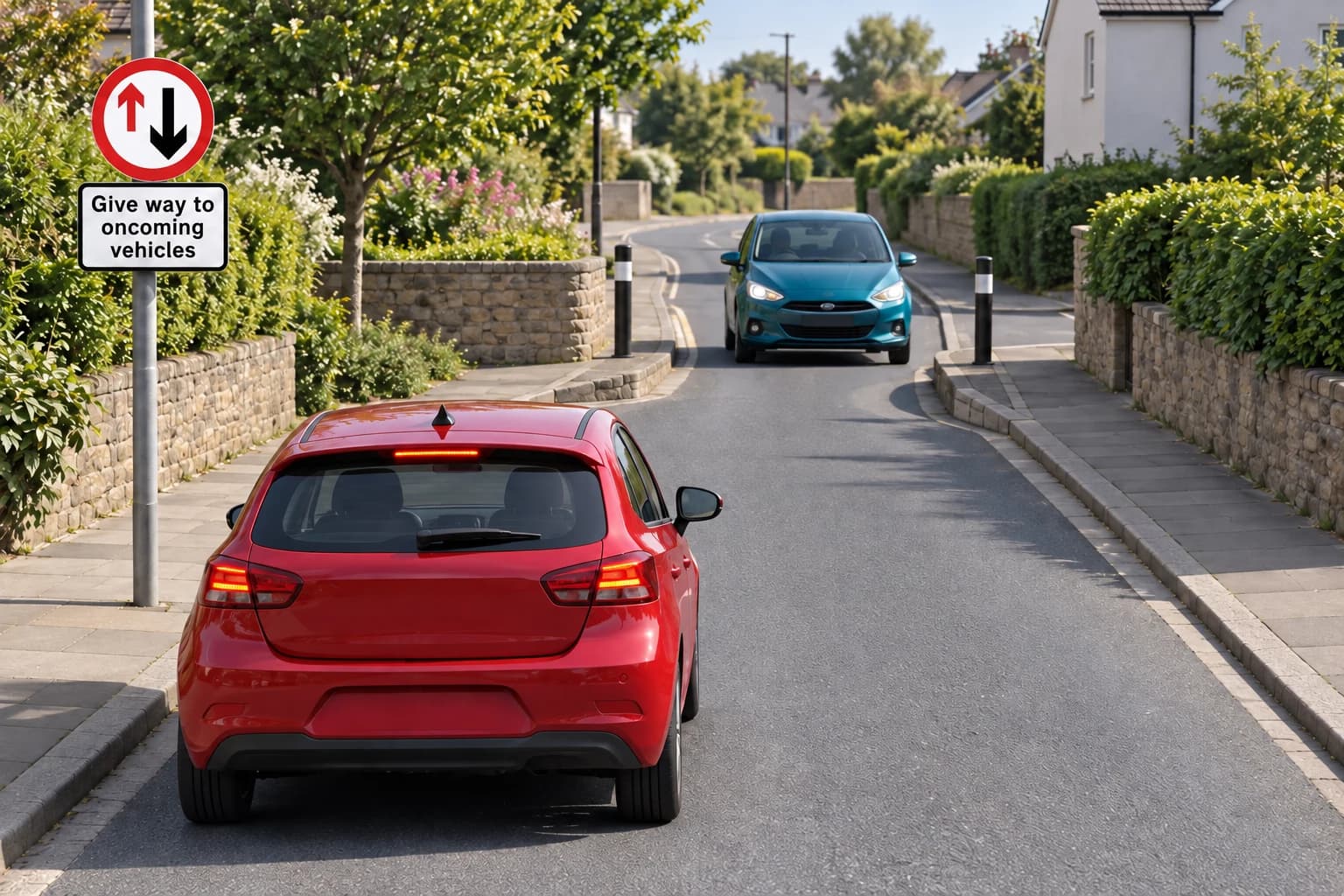
1. What does Wandsworth Code 37 mean?
Code 37 means that your vehicle is alleged to have failed to give priority to traffic coming from the opposite direction. It usually concerns a narrow stretch where vehicles cannot comfortably pass each other and signs tell one approach to give way.
This is a priority restriction, not a ban on using the road. The important question is whether you should have yielded when you proceeded. Review where the oncoming vehicle was, what you could see and how both vehicles moved, rather than relying on a single photograph of your car beyond the sign.
- Contravention
- Code 37: failing to give way to oncoming vehicles
- Issuing authority
- London Borough of Wandsworth
- Formal representation deadline
- 28 days beginning with service of the PCN.
- Penalty and discount
- Use the charge and discount printed on your PCN; the applicable amount depends on the notice and contravention date.
- Initial discount
- The initial 50% discount applies during the first 14 days beginning with the date of the PCN. A challenge does not automatically extend that period. Check the council's policy and any renewed offer in its reply.
- Appeal route
- Wandsworth, then London Tribunals after a formal Notice of Rejection.
2. What must Wandsworth establish?
The evidence must establish the priority instruction facing your approach and the alleged failure to give way. Diagram 615 is enforceable as a traffic sign without an underlying traffic order; the absence of an order alone is not a reason to cancel this allegation.
Diagram 615 is the red-bordered circular sign with a small red upward arrow on the left and a larger black downward arrow on the right. It tells traffic facing it to give priority to vehicles coming the other way. At the start of the priority section, the accompanying plate says 'Give way to oncoming vehicles', with a distance where appropriate.
The circular sign must have its associated plate. The blue diagram 811A sign faces the opposite approach and tells those drivers that they have priority. The two signs communicate different instructions; a photograph of the blue sign alone does not establish what faced the vehicle receiving the PCN.
A give-way road marking can identify the waiting point but is not compulsory at every narrowing. The triangular upright GIVE WAY sign used at junctions is not the prescribed substitute for diagram 615 at this type of priority section.
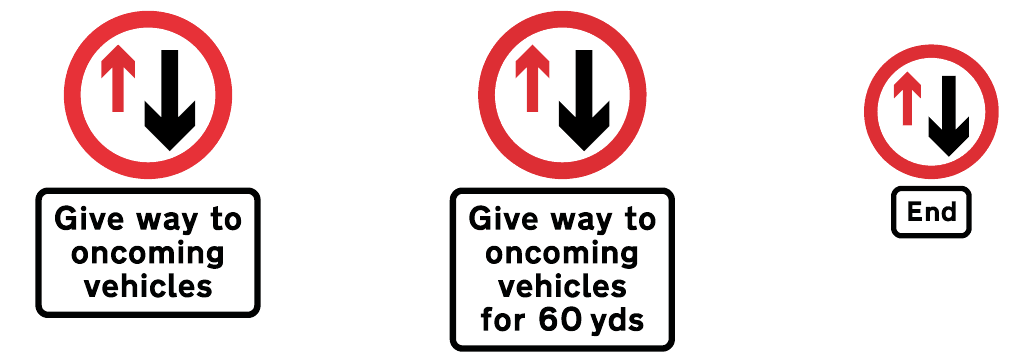
- The relevant sign and plate: identify what faced the vehicle, where the narrowing began and whether the instruction could be understood from that approach.
- The movement of both vehicles: the recording should show when your vehicle proceeded, where the oncoming vehicle was and its subsequent movement. A short clip starting after entry may omit the disputed decision point.
- The driver's view: compare the elevated camera view with approach photographs. Check foliage, high-sided traffic, sign orientation and the sight line through the narrowing.
- Any give-way line: where one is present, identify the nearer line to the narrowing and both vehicles' positions when it was crossed. Its statutory test concerns likely danger or making the opposing driver change speed or course to avoid an accident.
- Night-time visibility: direct lighting requirements depend on the road speed limit, nearby street lighting and the applicable exceptions. An unlit sign is not automatically defective on every road.
- The notice and liable person: check the registration, recorded journey, allegation and owner or qualifying-hire evidence.
3. Grounds and exemptions for a Wandsworth Code 37 appeal
Use a ground supported by the recording and documents. A moving oncoming vehicle does not have to collide with yours for a contravention to occur, and saying that nobody stopped is not a complete answer to a failure-to-give-priority allegation.
The priority sign does not contain a general exemption for residents, deliveries, taxis, motorcycles or Blue Badge holders. A smaller vehicle or a familiar route does not by itself remove the requirement to give way.
Following the vehicle ahead is not an exemption. If a van or bus blocked your view, distinguish a sign that was genuinely hidden from proceeding before you could check for oncoming traffic. The decisions below show why this distinction can change the outcome.
If you rely on a specific legal exception or an instruction given at the scene, identify it and provide the supporting evidence. Urgency, congestion or an unfamiliar route may instead be reasons to ask the authority to exercise discretion. They do not automatically establish a legal ground for cancellation.
- The contravention did not occur: use timestamped frames to explain why the oncoming vehicle's position and distance did not require you to wait when you proceeded.
- You had already given way: show the vehicles you allowed through, when you moved and how the next oncoming vehicle approached. Earlier compliance matters only if the later movement was also lawful.
- The sign or plate was missing, obscured or inadequately positioned: provide evidence from your approach at the relevant time, not just a close-up taken beside the sign.
- The recording does not prove the allegation: identify a missing part of the approach, an unseen opposing vehicle or a mismatch between the footage and sign photographs.
- You were not the liable owner, the vehicle was used without consent or a qualifying hire applies: provide the dated documents relevant to that ground.
- The penalty exceeds the amount applicable: compare the amount demanded with the scheme and circumstances on the notice.
4. How to make a formal representation to Wandsworth
Send formal representations to Wandsworth within 28 days beginning with service of the Code 37 PCN. Explain the ground relied upon and attach the evidence supporting it.
The initial 50% discount applies during the first 14 days beginning with the date of the PCN. A challenge does not automatically extend that period. Check the council's policy and any renewed offer in its reply.
- Open Wandsworth's PCN service below. Enter the PCN reference and vehicle registration to find the notice and evidence.
- Use the PCN number and vehicle registration to view evidence or start a challenge. Do not pay if you intend to challenge, because Wandsworth says payment closes the case.
- Prepare up to four supporting files, no larger than 10MB each and 23MB in total. Accepted formats include DOC, DOCX, JPEG, PDF, PPT and open document formats.
- For moving-traffic PCNs, Wandsworth directs the registered keeper to make a formal representation on receipt of the PCN. There is no informal representation stage for moving traffic.
- Explain which part of the Code 37 allegation you dispute. Include the PCN reference, vehicle registration, your address and copies of photographs or records supporting each point.
- Save the full submission, attachments and dated acknowledgement.
5. How long does Wandsworth have to respond?
London Tribunals says the authority "should normally respond to representations within 3 months". Keep Wandsworth's acknowledgement and the date your representations were received.
[11]6. If Wandsworth rejects your representation
A formal Notice of Rejection explains Wandsworth's decision and how to appeal to London Tribunals. You have 28 days beginning with service of that notice to pay or register your tribunal appeal.
Compare the reply with the Code 37 grounds and evidence you submitted. Identify any unanswered point, missing evidence or inconsistency between the restriction and the recorded event. Keep the rejection notice and the appeal details supplied with it.
[11]7. Taking your Wandsworth appeal to London Tribunals
London Tribunals is independent of Wandsworth. Use the registration instructions and verification details in the Notice of Rejection, upload your evidence and explain why the alleged Code 37 contravention or liability is disputed.
There is no fee to register the appeal. If it is refused, the full penalty is normally payable; an earlier discount does not automatically continue. If registering late, explain the delay so the adjudicator can decide whether to accept the appeal.
Read Wandsworth's evidence pack and respond to the points relevant to your case. Keep to the tribunal's directions and evidence deadlines.
[11][12]Tribunal examples relevant to Code 37
These London Tribunals decisions illustrate issues relevant to Code 37. They involve the authorities named below, not necessarily Wandsworth. Use the reasoning that matches your evidence; these are not Wandsworth-specific outcomes.
The opposing van was still too far from the narrowing to require waiting
Case 2250483803 / 2025-10-21 / Adjudicator Sean Stanton-Dunne
Sean Stanton-Dunne allowed the appeal after finding that the vehicle had already given way and reached the narrowing while the opposing van was still coming off a mini-roundabout. The distance and sequence did not establish a failure to give priority.
Read the case commentary“I find from the evidence that the alleged contravention did not occur.”
Sean Stanton-Dunne, case 2250483803
The elevated camera view did not establish a conspicuous sign from the driver's position
Case 2250488487 / 2025-10-20 / Adjudicator Martin Hoare
Martin Hoare allowed the appeal because high-sided vehicles obscured the driver's view. Although the enforcement camera could see the priority sign, the adjudicator found that it was not conspicuous from the driver's position in these circumstances.
Read the case commentary“The signage was not adequate in these particular circumstances.”
Martin Hoare, case 2250488487
Following a van did not excuse failing to check for oncoming traffic
Case 2250424214 / 2025-12-29 / Adjudicator Anju Kaler
Anju Kaler refused the appeal after finding that a motorcycle followed a white van which had itself failed to give way. The restriction was properly signed, and an obstructed view did not justify continuing without checking for approaching traffic.
Read the case commentary“If the driver could not see what was going on because his view was obstructed, he should have waited until he could see if there were any oncoming vehicles.”
Anju Kaler, case 2250424214
2025 London Tribunals results: shared context
18 of 81 recorded cases were allowed (22.2%).
| Recorded outcome | Cases |
|---|---|
| Allowed | 18 |
| Refused | 63 |
| Total | 81 |
Full Code 37 PCN Appeal Guide
Read the detailed legislation, signage requirements, exemptions and case analysis for this contravention.
Read the full Code 37 PCN Appeal GuideSources and references
- Standard contravention codes
Linked contravention code list, page 2: Code 37, failing to give way to oncoming vehicles; suffix j.
- TSRGD 2016, Schedule 3
Part 2 item 9, diagram 615: Part 4 provisions 1 and 4; Part 5 direction 3; associated plates in Part 3 items 5, 9 and 10. Supplied statutory PDF checked, pages 70 and 76-80; regulation 8 on page 11.
- TSRGD 2016, Schedule 11
Part 2 item 1, diagrams 811A and 811B: priority from the opposite approach and its end.
- Traffic Signs Manual, Chapter 3 (2019)
Paragraph 1.2.6; section 4.8, printed pages 37-38 (PDF pages 39-40), including Figures 4-27 to 4-29. Sign use, plates, sight lines and optional markings.
- TSRGD 2016, Schedule 9
Part 6 item 3, diagram 1003A; Part 7 paragraph 7(c), give-way line before a narrowing. Supplied PDF pages 148 and 164-165.
- London Local Authorities and Transport for London Act 2003
Section 4, Schedule 1 and Schedule 3: sign-based enforcement, owner liability, representations, appeals and scheduled signs.
- London Tribunals: moving-traffic PCN enforcement
Representation receipt within 28 days of PCN service; normal three-month response expectation; 28-day tribunal appeal period after rejection.
- London Tribunals: registers of appeals
Search the linked case references. Statistics use the supplied archive, 2025 decision dates and the exact 'Failing to give way to oncoming vehicles' label.
- London Councils: parking and traffic charges
Minor moving-traffic charge £160 with 50% early-payment reduction. This borough scheme is not a universal amount for every London notice.
- England's 2022 charging guidelines
Schedule 3 paragraphs 1-2: higher-level moving-traffic bands £60 or £70 and 50% discounted amounts. Apply the correct scheme and band.
- London Tribunals: moving-traffic enforcement process
Representations within 28 days of service, normal three-month response and appeal after rejection.
- London Tribunals: preparing your appeal
Registering an appeal, verification details and supporting evidence.
- Wandsworth: challenge a PCN
Opening evidence and challenge instructions; Supporting evidence; Start challenge link
- Wandsworth: pay or challenge a Penalty Charge Notice
PCN number and vehicle registration fields; reached through the council's Start challenge link
- Wandsworth: moving traffic representations
Moving traffic contraventions; registered-keeper formal representation instruction; no informal representation stage
- Wandsworth: informal representations and discount re-offer
Make an informal representation against a PCN; eligible notice types and 14-day discount re-offer
About Parking Mate UK
We assess real Code 37 decisions to identify the evidence that matters at a priority narrowing: the sign and plate, the driver's sight line and where each vehicle was when the driver proceeded.
The 2025 London-wide analysis above covers 81 decisions: 18 allowed and 63 refused. Its stated category scope applies; these are not Wandsworth-only figures.
Send us your Wandsworth Code 37 PCN for a free assessment. Parking Mate UK prepares and submits your formal representation to Wandsworth and handles your London Tribunals appeal, with support online and on WhatsApp.
Check Your PCN