Parking Mate UK
Keep-left and keep-right sign appeals
Code 38 PCN Appeal: Keep-Left and Keep-Right Signs
Received a Code 38 PCN for passing the wrong side of a traffic island or bollard? The diagonal arrow, your approach and the route around the island determine the allegation. Parking Mate UK checks the CCTV, sign visibility and any obstruction or width restriction, then prepares and submits your formal representation.
Start with a free Code 38 assessment. Our £9.99 Automated Penalty Charge Appeal Service includes preparing and submitting your formal representation and tribunal appeal.
Check Your PCN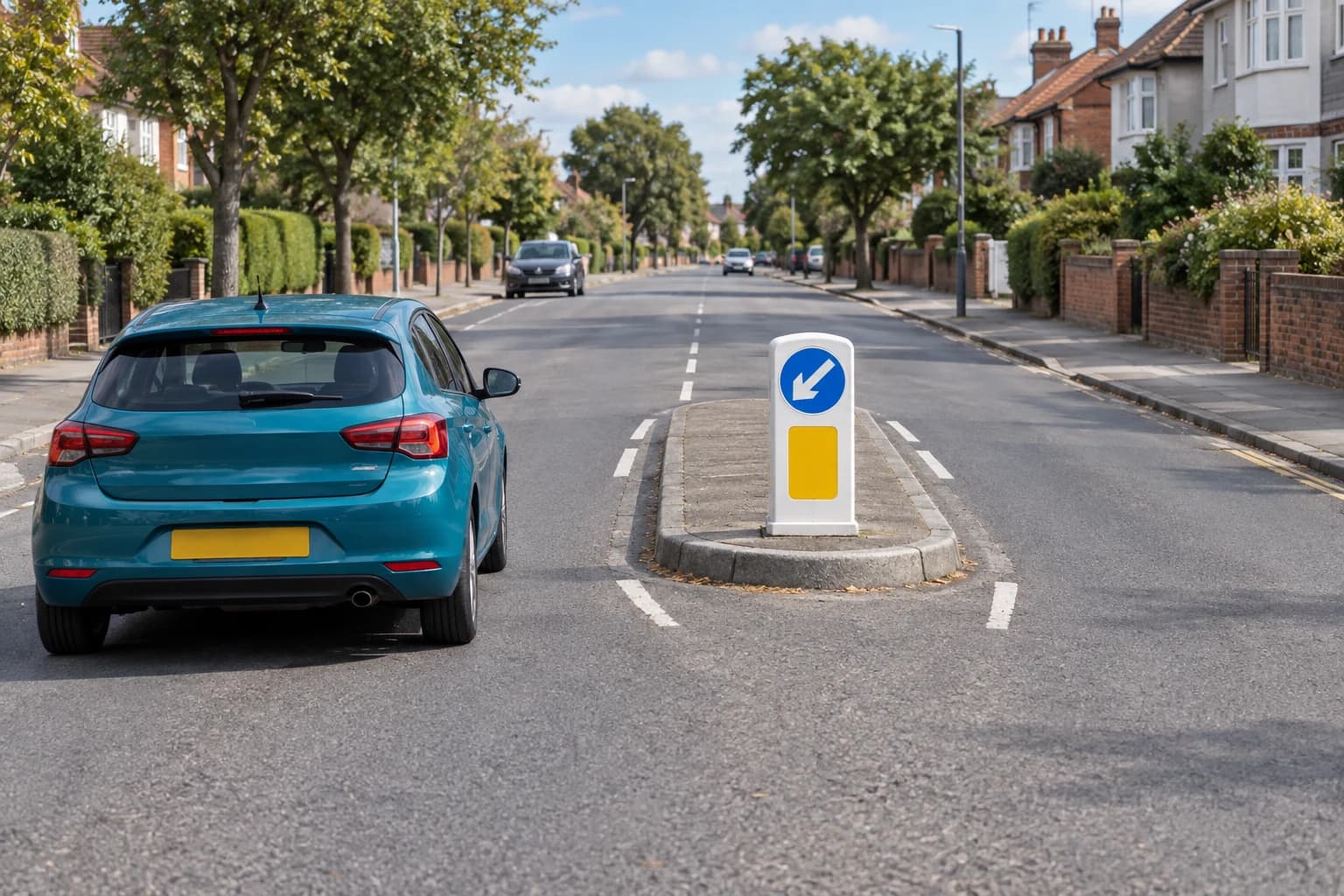
1. What does contravention Code 38 mean?
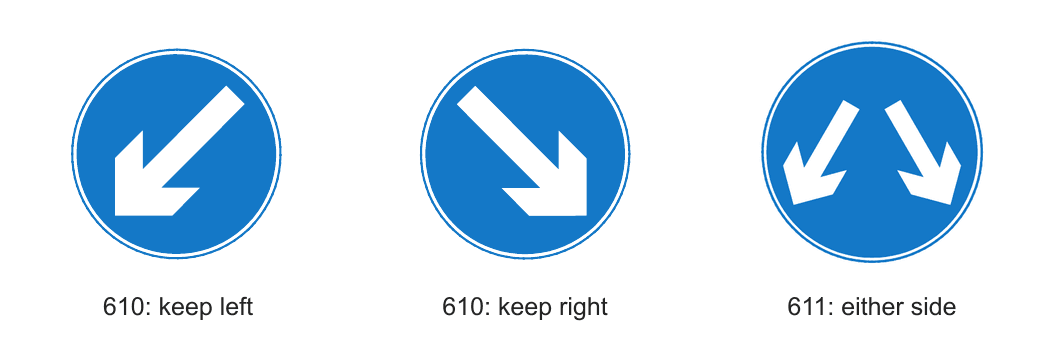
Code 38 means that your vehicle is alleged to have passed on the wrong side of a keep-left or keep-right sign. The sign is a blue circle with one white arrow pointing diagonally downwards. Down-left means pass to the left of the sign; down-right means pass to its right.
The allegation often arises at a traffic island or a narrow gap beside a bollard. Code 38l identifies a requirement to pass to the left and Code 38r to the right. Passing through a wider gap on the other side can establish the contravention even when the road is empty.
- Contravention
- Code 38: failing to comply with a sign requiring traffic to pass on its specified side
- Typical restrictions
- Keep-left or keep-right signs on traffic islands, pedestrian refuges, central reservations and width-restriction layouts
- Main evidence
- The front of the diagonal-arrow sign, the side passed on CCTV, approach visibility, bollard condition and any obstruction
- Penalty amount
- London: £160, reduced to £80 during the initial discount period. England outside London: £60 or £70, reduced to £30 or £35, according to the applicable charging band. Follow the notice for Wales and the discount deadline.
- Representations
- For a London Code 38 PCN, the authority must receive your representation within 28 days of service of the PCN
- Appeal route
- Formal representations to the issuing authority; after rejection, London Tribunals in London or the Traffic Penalty Tribunal under the relevant schemes elsewhere
2. Which signs apply, and what does either side mean?
Diagram 610 is the keep-left or keep-right sign. It directs traffic past the side of the sign indicated by its single diagonal arrow. Check the sign front facing your approach, not an arrow intended for traffic coming the other way.
Diagram 611 shows two downward arrows. It is an information sign indicating that traffic can pass either side and reach the same destination immediately beyond. It is not a keep-left restriction, and a photograph of 611 cannot by itself establish a failure to obey 610.
Straight left, right or ahead arrows at a junction, and bent turn-ahead arrows, give a different instruction. Those are diagrams 606 and 609, normally relevant to Code 32. Do not confuse turning at a junction with passing on a specified side of a sign.
3. What must the authority prove?
The evidence must identify the relevant sign and show your vehicle passing on the prohibited side. The presence of a bollard or a narrow gap does not, on its own, explain which instruction your vehicle was alleged to have disobeyed.
- The actual sign: establish a diagram 610 arrow facing the vehicle's approach and the side it required traffic to use. A plain bollard or diagram 611 is not interchangeable with it.
- The recorded passage: the complete CCTV should identify the vehicle, approach, sign and side passed. Check whether the recording or supporting photographs genuinely establish the sign front at the incident date.
- A readable approach: compare dated photographs with the recording for damage, rotation, parked vehicles, foliage or temporary works. Where a width restriction is involved, examine advance warnings and the point at which a driver could still change route.
- The applicable lighting rule: a sign on a road above 20 mph and within 50 metres of a street-lighting lamp is subject to the conditional direct-lighting requirements in Schedule 3 Part 4 paragraph 4. Self-righting bollards and temporary roadworks signs have specified exceptions; an internally lit bollard has its own requirement.
- The legal basis: diagram 610 can be used without a traffic order. If the authority also relies on an order for a width restriction or other control, check its actual terms and extent rather than assuming the missing order alone defeats the keep-left allegation.
- Liability and notice: check the PCN description, service and liable owner. A vehicle identity, ownership or hire dispute needs the relevant photographs or dated documents.
4. Grounds for appealing a Code 38 PCN
Choose the issue that the evidence can establish. Explain why it changes whether your vehicle contravened this sign, rather than simply saying that the wider route seemed easier.
- The wrong sign or side has been identified: show the actual arrow, your approach and the route taken. Check whether the sign was 610 or the two-arrow 611.
- The keep-left or keep-right instruction was not adequately visible: provide photographs or footage showing a damaged, turned, obscured or poorly visible sign and the relevant conditions at the time.
- A width-restriction approach was inadequately explained: identify unreadable or missing warning evidence and show where the driver could last have chosen another route. This depends on the particular layout, not a universal requirement for an extra warning sign.
- A genuine obstruction left no realistic safe alternative: document the parked or stopped vehicles, available gap, vehicle dimensions and why turning back was not practicable. Difficulty judging the gap or preferring the wider route is not the same issue.
- A specific exception or police direction applied: explain the vehicle's qualifying use or the direction given, with supporting records. Do not rely on an assumed exemption for all urgent journeys.
- The vehicle was not yours, you were not the liable owner, it was used without consent, or a qualifying hire transfers liability: attach evidence appropriate to the ground.
5. Exceptions, blocked routes and mitigation
TSRGD makes specific provision for vehicles used for listed purposes, including ambulance, fire and police work, where obeying the keep-side requirement would be likely to hinder that use. The replacement requirement is that the vehicle must not pass beyond the sign in a manner or at a time likely to endanger anyone. The ordinary keep-side requirement also does not apply to tramcars or trolley vehicles.
A Blue Badge, Motability vehicle, delivery or wide vehicle is not a general exemption from a keep-left sign. A private journey to help an unwell passenger does not automatically satisfy the listed emergency-purpose provisions.
Where parked vehicles, an incident or police directions affected the route, explain exactly what happened and support it with the full recording, photographs or other records. The allowed obstruction example below turned on the adjudicator's finding that there was no realistic alternative; it was not permission for every large vehicle to use the other gap.
If your circumstances amount to mitigation rather than a legal ground, ask the authority to exercise discretion and provide evidence. London adjudicators cannot allow an appeal on general mitigation alone. Correcting the route after passing the sign does not necessarily undo the first passage.
[2][7][12]6. How to make a formal representation
For a London Code 38 PCN, submit formal representations to the issuing authority using the details on the notice. London Tribunals states they must be received "within 28 days of the date the Penalty Charge Notice is served".
Outside London, use the submission route and deadline on the notice under the applicable English or Welsh scheme.
- Open the official evidence and challenge portal shown on the PCN. Enter the notice reference and vehicle registration.
- Watch the whole recording and identify the sign front, arrow direction and side your vehicle passed. Keep evidence of the approach, lighting or obstruction if disputed.
- State the ground and explain the specific issue: wrong sign or side, unclear signing, inadequate approach warning, unavoidable obstruction, exception or liability. Attach photographs, a marked plan and any relevant documents.
- Identify any missing footage or dated sign evidence needed to resolve the point. Submit by the deadline and retain the representation, attachments and dated acknowledgement.
Will appealing affect the 50% discount?
The 50% reduction is an early-payment discount, not a discount for making an appeal. Check the reduced amount and payment deadline on your PCN before deciding whether to pay or challenge it. The discount deadline and the deadline for representations are not necessarily the same.
An early challenge may give you another opportunity to pay the discounted amount if it is rejected. Check the issuing authority's policy and the terms of its reply; a renewed discount is not automatic for every notice. Submit through the correct challenge route and keep the dated confirmation.
If you take the case to the tribunal, do not assume the discount remains available. An allowed appeal cancels the penalty. If the appeal is refused, the full penalty is normally payable. Read the rejection and tribunal decision for the payment instructions.
7. How long does the authority have to respond?
London Tribunals states that the authority "should normally respond to representations within 3 months".
For formal representations under England's 2022 regulations outside London, the authority must serve its decision within 56 days of receiving them. Welsh Government guidance also states a 56-day response period under the separate Welsh regulations.
[7][9][8][15]8. Check the Notice of Rejection and evidence
The Notice of Rejection should explain the authority's decision and give the tribunal appeal instructions. Check whether it addresses the actual dispute: the arrow facing your approach, its visibility, the side passed or the obstruction that affected your route.
For a width-restriction case, compare the warning photographs with your approach and the available turn before the island. For a lighting dispute, check whether the evidence identifies the bollard type and conditions at the time. If an exception was raised, read the response against the specific provision relied on.
Record the date of service and the appeal deadline. Keep the PCN, representation, acknowledgement, rejection and evidence together. Review any tribunal evidence pack for gaps or differences from the material already supplied.
[7][10][2][12]9. Taking a Code 38 appeal to the tribunal
For a London PCN, register your appeal with London Tribunals within 28 days beginning with service of the Notice of Rejection. Use its verification details, select the relevant ground and explain how the sign, passage or approach evidence supports your case.
Outside London, the Traffic Penalty Tribunal handles the relevant English and Welsh schemes. Use the appeal details in the rejection. Both tribunals are independent and normally charge no appeal fee; if the appeal is refused, the full penalty is normally payable.
Organise the evidence around the island: your approach, the sign front, the required gap and the recorded route. If an obstruction matters, show why a different route or a safe turn was not realistically available. Link any earlier decision to that specific issue rather than assuming the same location guarantees the same result.
[7][10][11][12]Recent Code 38 tribunal decisions
Two allowed appeals and one refusal show how approach warnings, a genuine obstruction and an available alternative route can change the outcome. Full case details and authority attribution are available in each commentary.
The evidence did not establish usable warning before the width restriction
Case 2250291799 / 2025-10-14 / Adjudicator Chez Cotton
Chez Cotton allowed the appeal because the authority's advance-warning photographs were unreadable and the restriction sign at the location came too late for this driver to change course. The terminal signs and recorded passage were not the missing evidence.
Read the case commentary“For these reasons I find the PCN has not been validly issued.”
Chez Cotton, case 2250291799
Parked vehicles left no realistic safe alternative for the lorry
Case 2250278688 / 2025-10-09 / Adjudicator Philippa Alderson
Philippa Alderson allowed the appeal after finding that parked vehicles made the required passage extremely challenging or impossible and that turning back would also have been potentially dangerous. She expressly limited the decision to its facts.
Read the case commentary“In the specific circumstances of this case I find that no realistic alternative was open to the driver.”
Philippa Alderson, case 2250278688
Advance warnings and an available turn defeated the width argument
Case 2250427289 / 2025-12-29 / Adjudicator Darminder Lehal
Darminder Lehal refused the appeal after accepting the signs, advance width warnings and evidence of a left turn before the restriction. Concern about fitting through the gap did not justify passing on the wrong side.
Read the case commentary“I am satisfied the contravention occurred and no ground of appeal is established nor is an exemption applicable.”
Darminder Lehal, case 2250427289
2025 London Tribunals Code 38 results
34 of 194 recorded cases were allowed (17.5%).
| Recorded outcome | Cases |
|---|---|
| Allowed | 34 |
| Refused | 160 |
| Total | 194 |
Sources and references
- Standard contravention codes
Linked standard code list: Code 38 and suffixes l/r; distinguish Code 32 mandatory direction at a junction.
- TSRGD 2016, Schedule 3
Schedule 3 Part 2 item 3: diagram 610; Part 4 provisions 1, 2, 3, 4; Part 5 direction 2 only; associated plate Part 3 item 2. Supplied PDF pages 69 and 76-80 checked.
- TSRGD 2016, Schedule 11: pass either side
Part 2 item 73, diagram 611: same destination by proceeding either side of the sign. Supplied statutory PDF page 216; read with TSM 4.7.4.
- Traffic Signs Manual, Chapter 3 (2019)
Chapter 3 paragraphs 4.7.1-4.7.5: 610 may be erected without an order; traffic-island use, 611 either-side information and bollard/post mounting. Section 4.2 distinguishes junction-direction signs.
- Local Authorities' Traffic Orders Regulations 1996
Regulation 18: signs conveying an order's effect and their maintenance, where an associated width or other restriction relies on an order. Not a universal order requirement for diagram 610.
- London Local Authorities and Transport for London Act 2003
Section 4 and Schedule 1: scheduled section 36 signs, prescribed orders, owner liability, representations and appeals.
- London Tribunals: moving-traffic PCN enforcement
London representations, response expectation and independent appeal stages.
- DfT: moving-traffic enforcement outside London
English moving-traffic procedure under the 2022 scheme.
- England's 2022 Representations and Appeals Regulations
Decision period for qualifying formal representations; not London's 2003 Act procedure.
- London Tribunals: preparing your appeal
Evidence and statutory grounds for the independent appeal.
- Traffic Penalty Tribunal: moving-traffic PCNs
Relevant appeal schemes outside London.
- London Tribunals: registers of appeals
Search the three case references linked from this guide. Statistics use the supplied Data-sheet cohort, unique references, 2025 dates and exact label 'Failing to comply with a keep left/right sign'.
- London-wide parking and traffic charges
Current moving-traffic charge: £160, with the applicable 50% early-payment reduction. Borough increases took effect on 7 April 2025.
- England's 2022 charging guidelines
Schedule 3 paragraphs 1-2: higher-level moving-traffic charges, bands of £60 or £70 and their 50% discounted amounts; apply the correct local band.
- Welsh Government: moving-traffic enforcement guidance
Paragraphs 92-93: formal representations and the 56-day response period under the separate Welsh regulations.
About Parking Mate UK
We assess real Code 38 decisions to identify the evidence that matters in a keep-left or keep-right appeal: the arrow facing the vehicle, the side passed, approach warnings and any obstruction or exception.
Our 2025 keep-left/right analysis covers 194 London Tribunals decisions: 34 allowed and 160 refused. These cases help us distinguish a genuinely blocked or inadequately explained route from a clear restriction with an available alternative.
Send your Code 38 PCN for a free assessment. Parking Mate UK prepares and submits your formal representation and handles your tribunal appeal, with support online and on WhatsApp.
Check Your PCN