Parking Mate UK
Prohibited vehicle appeals
Code 52 PCN Appeal: How to Challenge a Vehicle Restriction PCN
Received a Code 52 PCN for passing a no-motor-vehicles or goods-vehicle restriction? The appeal depends on the vehicle class, the sign and any permitted access, loading or operating hours. Parking Mate UK checks the CCTV, traffic order and evidence of an exception, then prepares and submits your formal representation.
Start with a free Code 52 assessment. Our £9.99 Automated Penalty Charge Appeal Service includes preparing and submitting your formal representation and tribunal appeal.
Check Your PCN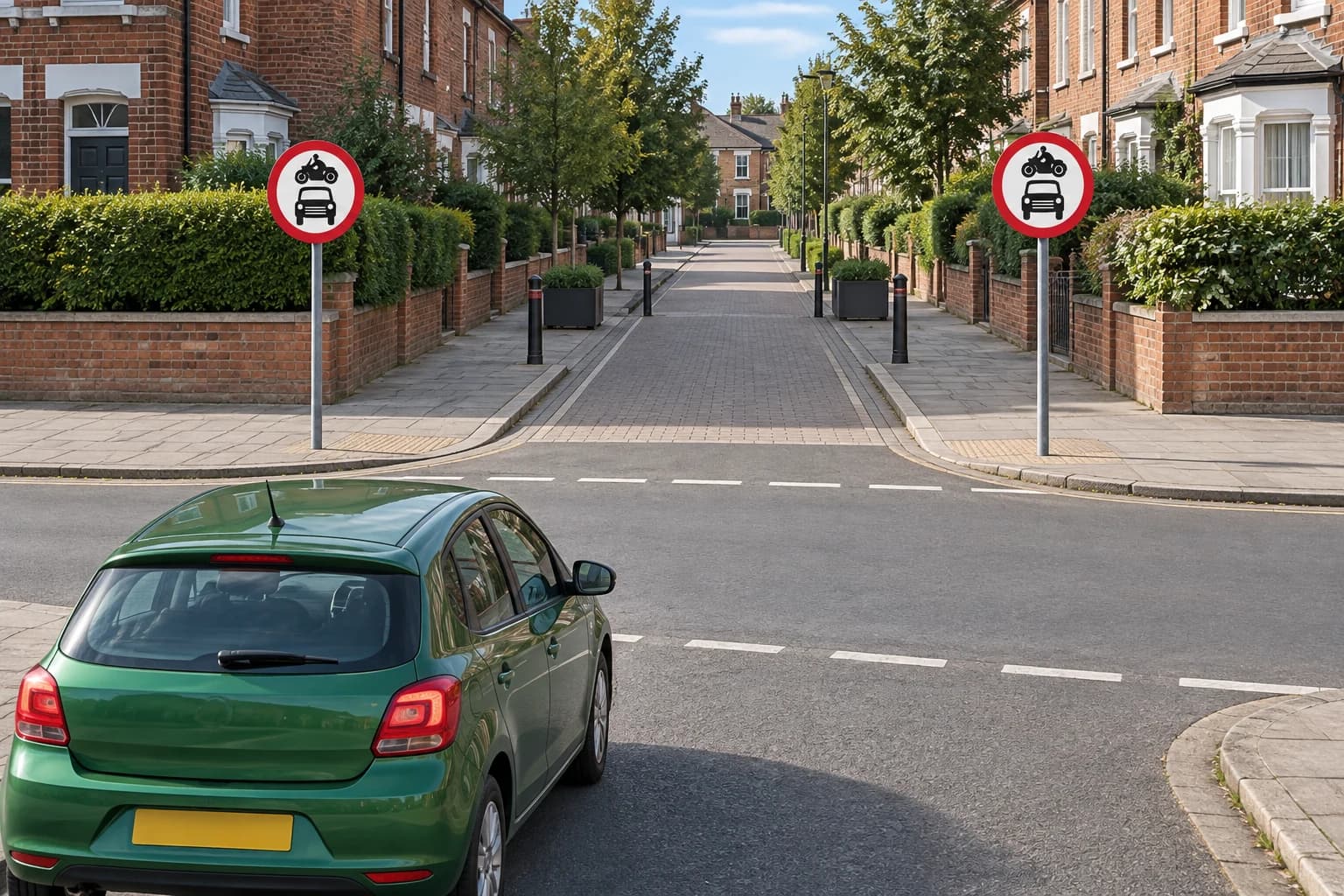
1. What does contravention Code 52 mean?
Code 52 means that the authority says your vehicle used a road from which its class of vehicle was prohibited. A car passing a no-motor-vehicles sign and a lorry passing a goods-vehicle weight restriction can both fall within this code, but the proof and available exceptions are different.
Start with the full allegation on the PCN. A 52M restriction usually concerns motor vehicles; a 52G allegation concerns goods vehicles above the maximum gross weight shown. The motorcycle-and-car symbol does not mean only motorcycles and cars are banned: it indicates a prohibition of motor vehicles. A bus gate with a blue route sign, a red no-entry sign and a pedestrian-zone entry have their own requirements and should not be treated as interchangeable.
- Contravention
- Code 52: failing to comply with a prohibition on certain types of vehicle
- Common variants
- 52M: motor vehicles; 52G: goods vehicles exceeding the stated maximum gross weight. Read the full wording and suffix on your notice.
- Main evidence
- Vehicle class or weight, the entry shown on CCTV, the restriction signs, traffic order and any exception
- Penalty amount
- London: £160, reduced to £80 during the initial discount period. England outside London: £60 or £70, reduced to £30 or £35, according to the applicable charging band. Follow the notice for Wales and the discount deadline.
- Representations
- For London's 2003 Act and England's 2022 scheme, normally within 28 days beginning with service. Welsh PCNs follow separate regulations.
- Appeal route
- Representations to the authority, then London Tribunals in London or the Traffic Penalty Tribunal under the relevant schemes elsewhere
2. Which signs apply to a Code 52 restriction?
For a no-motor-vehicles restriction, diagram 619 is the red circle containing a motorcycle above a car. It is prescribed by TSRGD 2016, Schedule 3, Part 2, item 12. Diagram 622.1A, item 13, shows a lorry with a maximum gross weight and is used for the goods-vehicle variant. A weight-only roundel without the lorry symbol is a different restriction.
Read any plate below the roundel. Times and exceptions such as permit holders, access or loading qualify the prohibition. Check that the plate, sign and operative traffic order describe the same restriction. Do not assume that every Code 52 sign must carry an exception: diagram 619 can operate without a supplementary plate.
Placement matters. Schedule 3 Part 5 direction 1 requires a terminal sign to be as near as practicable to the point where the restriction starts. Photograph the driver's approach, not just the sign close up. Chapter 3 of the Traffic Signs Manual explains why a driver should not encounter the prohibition only after committing to a turn. It does not impose a universal two-sign rule.
For a night-time allegation, check the lighting conditions as well as readability. Schedule 3 Part 4 paragraph 4 contains a direct-lighting requirement for these signs on roads above 20 mph within 50 metres of a street lamp, subject to its conditions and exceptions. An unlit sign on a 20 mph road is not automatically the same defect. Record the speed limit, lamps and sign condition.

3. What must the authority prove?
The authority needs a coherent restriction, sign and vehicle movement, not simply a photograph of a vehicle in a road. Where it relies on a traffic management order, request the operative order, amendments and the schedule or map identifying the restricted length.

- The restriction applied to that road and time: check the start and end points, direction, operating hours and any relevant order commencement or amendment.
- The vehicle fell within the prohibited class: for a goods-vehicle limit, establish the relevant maximum gross weight. An empty lorry is not necessarily below its permitted maximum, but the authority still needs evidence of the vehicle characteristic it alleges.
- The restriction was adequately signed from your approach: compare the actual signs, plates and visibility with the order and prescribed or specially authorised signing.
- The CCTV proves the relevant entry or use: check the registration, route, time and point of crossing, including whether the vehicle remained outside the restricted length.
- The notice and owner liability are correct: examine the actual documents for a vehicle-identification, ownership, hire, service or material wording issue. Do not import private-parking keeper-liability rules.
4. Grounds for appealing a Code 52 PCN
Use the ground supported by your documents and journey. A targeted representation explains exactly which part of the allegation fails.
- The prohibition did not cover your vehicle or journey: identify the class, maximum gross weight, road, direction or time that differs from the allegation.
- A permitted exception applied: provide the permit, destination, delivery record or other evidence showing the conditions in the order were met.
- The signs did not adequately convey the restriction: show an obscured or badly positioned sign, unreadable plate or misleading approach and explain its effect on the decision to enter.
- The legal extent was not established: identify a missing or inconsistent order schedule, map tile, amendment or location description rather than merely demanding every document the council holds.
- The notice was issued to the wrong liable person or contains a material defect: use dated ownership or compliant hire documents and the actual statutory requirements.
5. Access, loading and permit exceptions
An exception belongs to the particular restriction. A delivery elsewhere in the neighbourhood is not automatically access to premises covered by an 'Except for loading' plate. Read the order's definitions and geographical limits, then explain why this route was permitted for that destination.
For loading, give the address, date, nature of the collection or delivery and supporting job sheet, invoice or delivery record. If the order requires that there was no other access, show the available routes. An assertion that the driver was working is not the whole test.
For permit access, show that the vehicle and permit were valid for this restriction at the relevant time. A nearby resident's parking permit, Blue Badge, taxi licence or electric vehicle is not a blanket exemption from every Code 52 prohibition. Check the actual order and any applicable statutory exception.
Following a satnav, using a familiar shortcut or seeing no pedestrians does not itself establish an appeal ground. Explain emergencies or other compelling circumstances to the authority as a request for discretion where no legal exception applies. The tribunal cannot simply substitute sympathy for the statutory test.
[2][5][12][10]6. How to make a formal representation
For a London Code 52 PCN, submit formal representations to the issuing authority using the details on the notice. The authority must receive them within 28 days of service of the PCN.
Outside London, use the process and deadline on the notice under the applicable English or Welsh scheme. An evidence request does not automatically pause the representation deadline.
- Obtain the CCTV and record the entry point, direction, timestamp and sign seen on your approach.
- Match the PCN to the sign variant, vehicle class and operative order. For a weight allegation, include reliable vehicle specifications or plating evidence relevant to maximum gross weight.
- State the ground, explain the facts and attach numbered evidence. For access or loading, identify the exact premises and the order provision relied upon.
- Ask the authority to address the disputed points and provide the missing evidence or schedule. Submit before the deadline and retain the full text and confirmation of receipt.
Will appealing affect the 50% discount?
The 50% reduction is an early-payment discount, not a discount for making an appeal. Check the reduced amount and payment deadline on your PCN before deciding whether to pay or challenge it. The discount deadline and the deadline for representations are not necessarily the same.
An early challenge may give you another opportunity to pay the discounted amount if it is rejected. Check the issuing authority's policy and the terms of its reply; a renewed discount is not automatic for every notice. Submit through the correct challenge route and keep the dated confirmation.
If you take the case to the tribunal, do not assume the discount remains available. An allowed appeal cancels the penalty. If the appeal is refused, the full penalty is normally payable. Read the rejection and tribunal decision for the payment instructions.
7. How long does the authority have to respond?
For a London Code 52 PCN, London Tribunals says the authority should normally respond to formal representations within three months.
For formal representations under England's 2022 regulations outside London, the authority must serve its decision within 56 days of receiving them. For a Welsh PCN, follow the separate Welsh regulations.
[7][9]8. Check the Notice of Rejection and evidence pack
Compare the rejection with your actual representation. If you relied on a delivery exception, does it explain why the premises or route fall outside it? If you disputed vehicle weight, does it identify evidence of the relevant weight? A statement that CCTV shows the vehicle is not a complete answer to every vehicle-class dispute.
Check the tribunal instructions, date of service and any renewed discount offer. Request missing material, including the relevant order schedule or readable site photographs, without missing the tribunal deadline. When the authority uploads its pack, check that its signs, maps and legal restriction relate to the same road and date as your PCN.
[6][10][12]9. Taking a Code 52 appeal to the tribunal
Use London Tribunals for a London PCN, normally within 28 days beginning with service of the Notice of Rejection. Enter the details and verification information supplied with the rejection, identify the ground and provide your evidence. Organise a signage case around the approach; organise an exception case around the destination and order wording.
The Traffic Penalty Tribunal handles the relevant schemes outside London in England and Wales. Follow the rejection's instructions. Both tribunals are independent and normally have no appeal fee. If refused, the full penalty is normally payable; do not assume an earlier discount remains available. Costs are exceptional.
The decisions below illustrate the reasoning in individual cases. An allowed appeal at a nearby road does not cancel your PCN automatically. Explain the factual match, identify what has changed and link the case reference to the point you are making.
[7][11][10]Recent Code 52 tribunal decisions
Two allowed appeals and one refusal show the importance of the order schedule, the approach to the signs and proving an applicable exception.
Stockwell Terrace: the missing map-based schedule left the restriction unproved
Case 2250437205 / 2025-12-31 / Adjudicator Chez Cotton
Chez Cotton allowed the appeal after finding that the evidence did not identify the relevant map-based restriction and did not resolve the concerns about the signs. A link to a general website did not fill the gap.
Read the case commentary“The appeal is allowed based on no case to answer.”
Chez Cotton, case 2250437205
Royal Albert Way: the restriction was not clear before the driver committed to the route
Case 2250386793 / 2025-12-30 / Adjudicator Anju Kaler
Anju Kaler allowed this appeal because the approach did not adequately warn of the restriction before entry. The advance signs referred to traffic enforcement rather than explaining what restriction lay ahead.
Read the case commentary“I find the signage inadequate to warn motorists driving on the main road of this “part time” restriction ahead.”
Anju Kaler, case 2250386793
Kingswood Road: a garage visit did not establish an exception to the restriction
Case 2250420450 / 2025-12-31 / Adjudicator Graeme Wallington
Graeme Wallington refused the appeal because the claimed need to reach a garage did not fall within an exception in the traffic order. The circumstances were mitigation, not a proven statutory ground.
Read the case commentary“The TMO does not grant any exemption for the circumstances the Appellant relies upon.”
Graeme Wallington, case 2250420450
2025 London Tribunals Code 52 results
1,079 of 4,475 recorded cases were allowed (24.1%).
| Recorded outcome | Cases |
|---|---|
| Allowed | 1,079 |
| Refused | 3,396 |
| Total | 4,475 |
Sources and references
- Standard contravention codes
Linked contravention-code list: Code 52 and vehicle-specific suffixes. Read the complete wording on the notice.
- TSRGD 2016, Schedule 3
Part 2 items 12 and 13, diagrams 619 and 622.1A; associated plates in Part 3; Part 4 lighting provisions; Part 5 direction 1. Supplied statutory PDF also checked.
- Traffic Signs Manual, Chapter 3 (2019)
Sections 5.3, 5.7 and 5.17: motor vehicles, goods vehicles and sign siting. Guidance is distinct from mandatory legislation.
- Highway Code: traffic signs
Prohibitory red circles, vehicle symbols and qualifying plates.
- Local Authorities' Traffic Orders Regulations 1996
Regulation 18: information about the effect of an order and maintenance of signs.
- London Local Authorities and Transport for London Act 2003
Section 4 and Schedule 1: enforcement basis, representations, owner liability and rejection. Do not assume every Code 52 sign is a section 36 sign.
- London Tribunals: moving-traffic PCN enforcement
London representations, response expectation and independent appeal stages.
- DfT: moving-traffic enforcement outside London
English moving-traffic procedure under the 2022 scheme.
- England's 2022 Representations and Appeals Regulations
Decision period for qualifying formal representations; not London's 2003 Act procedure.
- London Tribunals: preparing your appeal
Evidence and statutory grounds for the independent appeal.
- Traffic Penalty Tribunal: moving-traffic PCNs
Relevant appeal schemes outside London.
- London Tribunals: registers of appeals
Search the references below. Statistics from the supplied archive's Data sheet, decision year 2025 and vehicle-prohibition allegation.
- London-wide parking and traffic charges
Current moving-traffic charge: £160, with the applicable 50% early-payment reduction. Borough increases took effect on 7 April 2025.
- England's 2022 charging guidelines
Schedule 3: penalty levels and reduced payment outside London. Follow the applicable notice and jurisdiction.
About Parking Mate UK
We assess real Code 52 tribunal decisions to understand the evidence that wins or loses a vehicle-restriction appeal: the sign on the approach, the order's geographical extent, the prohibited vehicle class and the exact access or loading exception.
Our 2025 vehicle-prohibition analysis covers 4,475 London Tribunals decisions: 1,079 allowed and 3,396 refused. Those decisions help us focus your representation on the issue that applies to your vehicle and route rather than a generic complaint about restrictions.
Send your Code 52 PCN for a free assessment. Parking Mate UK prepares and submits your formal representation and handles your tribunal appeal, with support online and on WhatsApp.
Check Your PCN