Parking Mate UK
Pedestrian-zone and School Street appeals
Code 53 PCN Appeal: Pedestrian Zones and School Streets
Received a Code 53 PCN after entering a pedestrian zone or School Street? The entry sign, operating hours and any permit or access exception determine whether your vehicle could enter. Parking Mate UK checks the recording, sign panels and traffic order, then prepares and submits your formal representation.
Start with a free Code 53 assessment. Our £9.99 Automated Penalty Charge Appeal Service includes preparing and submitting your formal representation and tribunal appeal.
Check Your PCN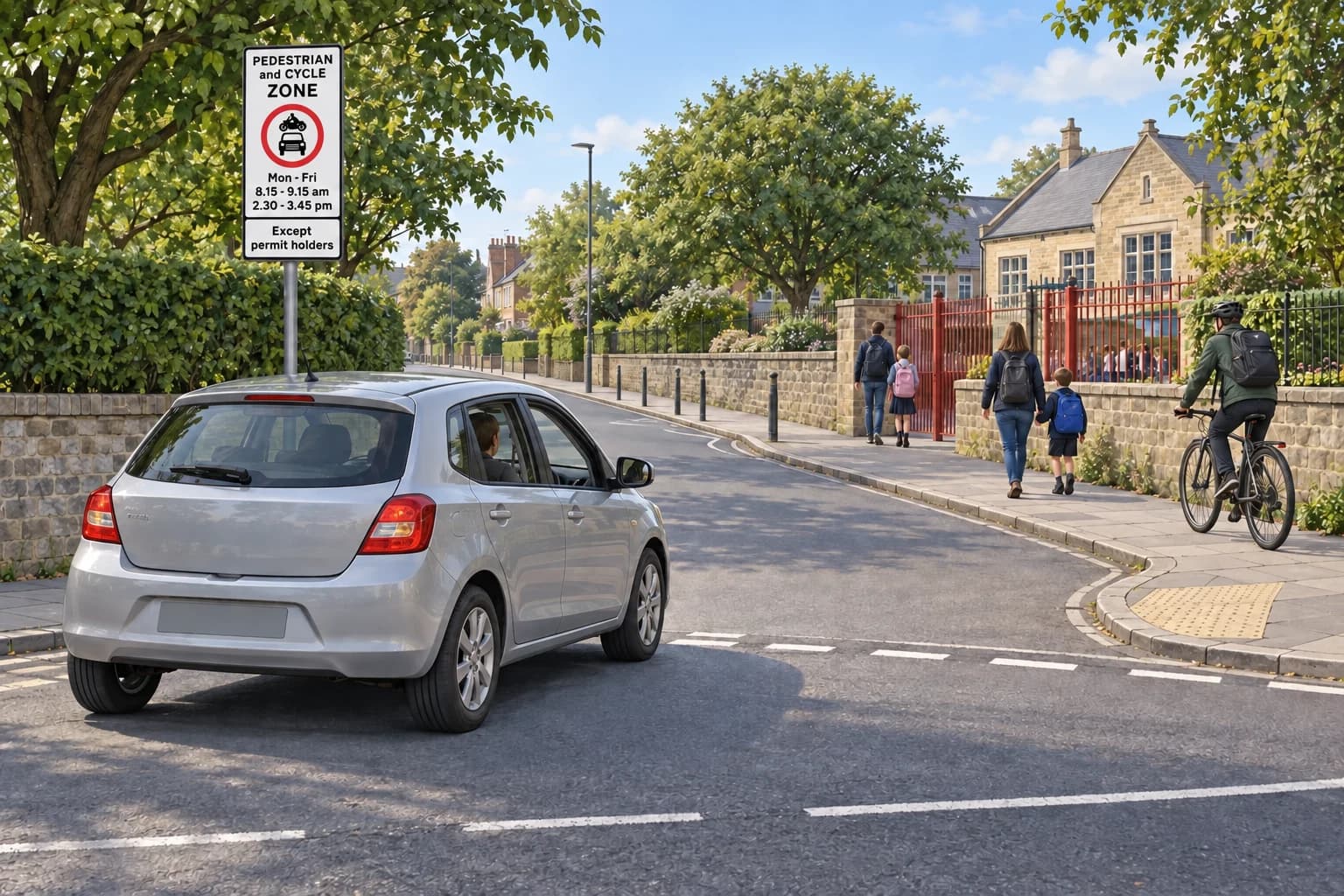
1. What does contravention Code 53 mean?
Code 53 alleges that your vehicle entered a pedestrian zone when entry was restricted. The restriction may apply throughout the day or only during the hours on the entry sign. It concerns entering the zone, not simply parking or waiting inside it.
A School Street often uses a timed pedestrian-and-cycle zone to restrict motor traffic around school arrival and collection. Other School Streets use a standalone no-motor-vehicles restriction. Read the actual PCN description and sign: the name School Street does not make every scheme a Code 53 restriction.
An empty road or a short visit does not itself permit entry. Check the date and time against the restriction and whether your vehicle or journey met an exception. School holidays are not automatically unrestricted: some schemes operate on weekdays throughout the year.
- Contravention
- Code 53: failing to comply with a restriction on vehicles entering a pedestrian zone
- Typical restrictions
- Pedestrian shopping streets, pedestrian-and-cycle zones and timed School Street entry restrictions
- Main evidence
- The entry sign facing your approach, its hours and exceptions, the operative traffic order, permit records and timestamped CCTV
- Penalty amount
- London: £160, reduced to £80 during the initial discount period. England outside London: £60 or £70, reduced to £30 or £35, according to the applicable charging band. Follow the notice for Wales and the discount deadline.
- Representations
- For a London Code 53 PCN, the authority must receive your representation within 28 days of service of the PCN
- Appeal route
- Formal representations to the issuing authority; after rejection, London Tribunals in London or the Traffic Penalty Tribunal under the relevant schemes elsewhere
2. Which signs apply to a pedestrian zone?
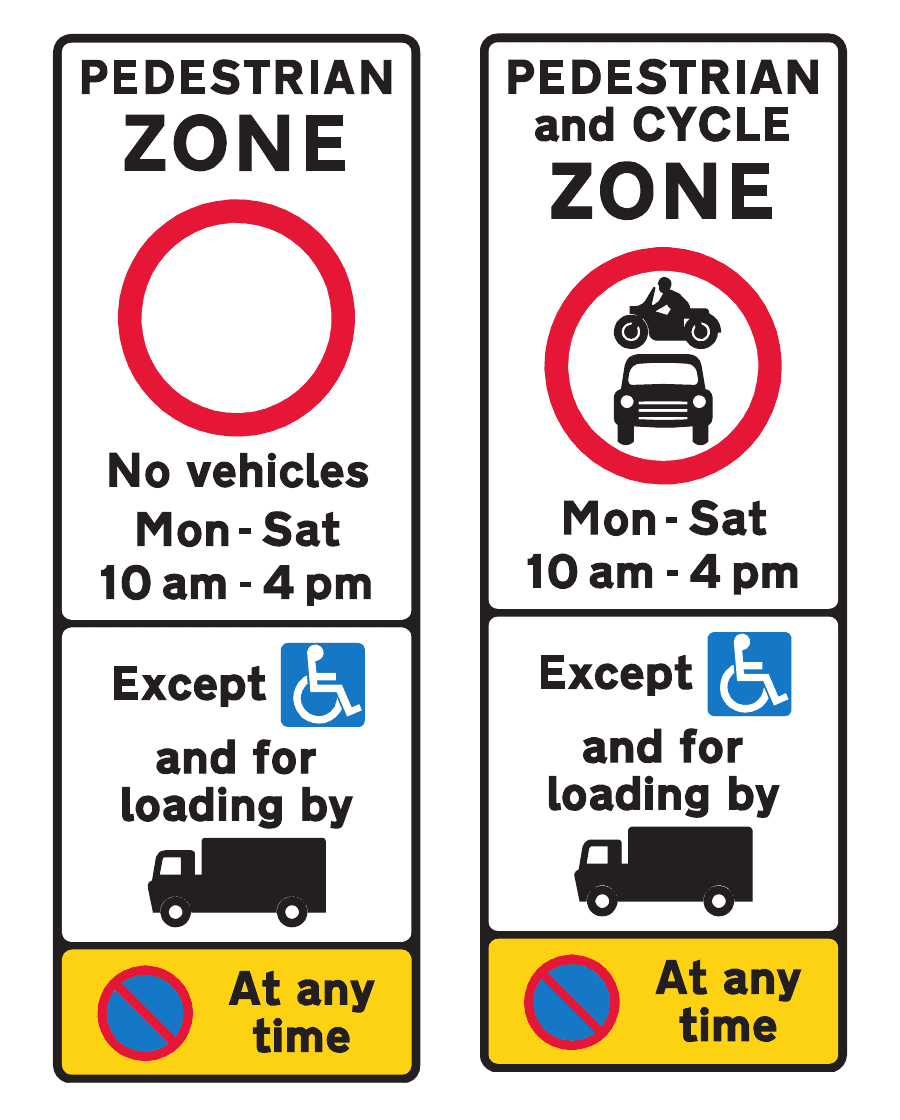
Diagram 618.3B has the heading PEDESTRIAN ZONE and an empty red-bordered circle above No vehicles. It prohibits vehicles, including ridden pedal cycles, subject to the displayed exceptions. Diagram 618.3C says PEDESTRIAN and CYCLE ZONE and contains the car-and-motorcycle symbol: it prohibits motor vehicles but permits ridden pedal cycles.
Read each panel separately. The upper panel gives the entry restriction and its operating period. The middle panel identifies exceptions, which may have their own times. A yellow lower panel concerns waiting inside the zone; its hours are not the entry hours. These panels must be read with the restriction in the traffic order.
The statutory examples below show particular times and exceptions, not universal School Street conditions. Permitted variants can change the hours and exceptions or omit the lower panel. Older pedestrian-zone signs using the no-motor-vehicles symbol are not automatically invalid merely because they lack the newer and CYCLE wording.
For a School Street, compare the sign displayed on the journey date with the order's school-day or weekday provisions. Where a folding or variable sign is used, establish what it actually displayed at the time.
3. What must the authority prove?
The allegation needs to match the legal restriction, signs and recorded entry. A vehicle photographed somewhere inside a zone does not, on its own, establish which entrance it used or when it crossed the boundary.
- The operative restriction: identify the traffic order, amendments and map or schedule covering this entry, direction, date and time. For a School Street, check any school-day definition rather than assuming the school calendar controls enforcement.
- Adequate entry signs: the relevant signs must communicate the restriction to traffic approaching that entrance. Check sign orientation, obstructions, readable hours and whether the driver could understand the restriction before entering. A pair of signs is not universally required.
- Correct placement: Schedule 8 Part 5 direction 2 requires the upright sign to be as near as practicable to where the restriction begins or ends. A distant warning sign does not resolve every defect at the entrance.
- Lighting where required: Schedule 8 Part 1 paragraph 2 sets direct-lighting requirements for these signs on roads above 20 mph when they are within 50 metres of a street-lighting lamp. Apply its conditions to the actual road and lighting operation, not to every School Street.
- The recorded movement: check the registration, entrance, direction and timestamp against the sign hours. Distinguish entry from a vehicle leaving after having entered lawfully earlier.
- Exceptions and liability: check any permit or qualifying journey against the order and the vehicle record, and whether the PCN was issued to the person legally liable.
4. Grounds for appealing a Code 53 PCN
Make the representation about the particular entry and evidence. State what is wrong and attach material that allows the authority to check it.
- The restriction was not operating: compare the video timestamp with the upper-panel hours and applicable order, including any relevant school-day provision.
- Your vehicle or journey was exempt: provide the permit, authorisation or evidence satisfying the actual access, loading or other exception.
- The sign was unreadable or visible too late: show the approach from the driver's direction, obstructions, sign angle and decision point. Date photographs so they can be compared with the enforcement footage.
- The evidence does not establish the entry: identify a missing boundary crossing, the wrong approach, inconsistent times or an order that does not cover the place alleged.
- The rejection misstates the restriction: quote the incorrect hours or exception and explain how the error affects the allegation or the consideration of your representation.
- You were not the liable owner, the vehicle was taken without consent, or a qualifying hire transfers liability: supply dated ownership, police or hire documents appropriate to the ground.
5. School Street permits, access and other exceptions
An exception belongs to the particular zone and order. The sign may identify permit holders, access, loading, buses, taxis or Blue Badge holders. Some operational exceptions, such as emergency or roadworks vehicles, may be contained in the order without appearing on the sign.
For a permit, establish that it covered this vehicle, zone and journey date. Keep the approval, vehicle-registration details and any evidence of an application or system problem. Permission granted later does not itself establish that the vehicle was exempt when it entered.
Living nearby, delivering a parcel, collecting a child or displaying a Blue Badge does not create the same permission in every zone. Check whether the order grants the exception directly or requires registration or a permit. Where an access or loading exception applies, provide evidence of the destination and purpose.
If a difficult journey or an application problem supports a request for discretion rather than a legal exception, explain that clearly and supply supporting records. The authority can consider mitigation; a London adjudicator cannot allow an appeal solely on that basis.
[2][3][4][7][13]6. How to make a formal representation
For a London Code 53 PCN, submit formal representations to the issuing authority using the details on the notice. London Tribunals states they must be received "within 28 days of the date the Penalty Charge Notice is served".
Outside London, use the submission route and deadline on the notice under the applicable English or Welsh scheme.
- Open the official evidence and challenge portal shown on the PCN. Enter the notice reference and vehicle registration.
- Review the complete CCTV. Record the entrance, direction and entry time, then compare them with photographs of every panel on the sign facing your approach.
- Explain your ground: operating hours, permit or access exception, sign visibility, missing entry evidence or liability. Attach the relevant photographs, approval or documents, and identify the order provision where available.
- Identify any missing evidence needed to resolve the point, submit the representation by the deadline and keep the full text, attachments and dated acknowledgement.
Will appealing affect the 50% discount?
The 50% reduction is an early-payment discount, not a discount for making an appeal. Check the reduced amount and payment deadline on your PCN before deciding whether to pay or challenge it. The discount deadline and the deadline for representations are not necessarily the same.
An early challenge may give you another opportunity to pay the discounted amount if it is rejected. Check the issuing authority's policy and the terms of its reply; a renewed discount is not automatic for every notice. Submit through the correct challenge route and keep the dated confirmation.
If you take the case to the tribunal, do not assume the discount remains available. An allowed appeal cancels the penalty. If the appeal is refused, the full penalty is normally payable. Read the rejection and tribunal decision for the payment instructions.
7. How long does the authority have to respond?
London Tribunals states that the authority "should normally respond to representations within 3 months".
For formal representations under England's 2022 regulations outside London, the authority must serve its decision within 56 days of receiving them. Welsh Government guidance also states a 56-day response period under the separate Welsh regulations.
[7][9][10]8. Check the Notice of Rejection and evidence
The Notice of Rejection should explain why the authority has rejected your representation and provide the tribunal appeal instructions. Check whether its hours, sign description and exception match the restriction it says you breached.
For a timed zone, compare the rejection with the sign's upper panel and operative order. For a visibility dispute, check that the photographs establish the signs facing your approach on the journey date. For a permit dispute, check whether the authority has addressed the approval and vehicle details you supplied.
Record the date of service and appeal deadline. Keep the PCN, representation, acknowledgement, rejection and supporting evidence together. Compare the authority's tribunal evidence pack with the points still in dispute.
[7][11][13]9. Taking a Code 53 appeal to the tribunal
For a London PCN, register your appeal with London Tribunals within 28 days beginning with service of the Notice of Rejection. Use its verification details, select the relevant ground and explain how the entry signs, hours, exception or recording support your case.
Outside London, the Traffic Penalty Tribunal handles the relevant English and Welsh schemes. Use the appeal details in the rejection. Both tribunals are independent and normally charge no appeal fee; if the appeal is refused, the full penalty is normally payable.
Organise the evidence around the entry: the approach, readable sign panels, restriction boundary, timestamp and any permission. Explain what the authority's documents do or do not establish. Previous decisions can illustrate the issue, but the adjudicator decides the evidence in your appeal.
[7][11][12]Recent Code 53 tribunal decisions
Two allowed appeals and one refusal show why readable operating hours, the approach to the signs and evidence of the actual entry matter. Full case details and attribution are available in each commentary.
Unclear entry times and an incorrect rejection undermined the PCN
Case 2250427438 / 2025-12-29 / Adjudicator Carl Teper
The appeal was allowed where the entrance-sign hours could not be established clearly and the rejection gave an incorrect afternoon start time. The adjudicator also found the entry signage inadequate.
Read the case commentary“it is not possible to see the times of the restriction on the CCTV footage provided to the Tribunal.”
Carl Teper, case 2250427438
Signs could not adequately inform a driver making the left turn
Case 2250419699 / 2025-12-24 / Adjudicator Chez Cotton
The appeal was allowed because the entry signs did not adequately communicate the restriction on the particular left-turn approach. The advance warning did not remedy the problem.
Read the case commentary“I therefore, find this signage in relation to the Appellant not to be substantially compliant, clear and adequate.”
Chez Cotton, case 2250419699
Clear timed-zone signs outweighed reliance on satnav
Case 2250432289 / 2025-12-31 / Adjudicator Teresa Brennan
The appeal was refused after the adjudicator accepted the signs, footage and opportunity to take another route. Following satnav during traffic disruption did not establish a ground of appeal.
Read the case commentary“Drivers need to look for traffic signs and not overly rely on their satnavs”
Teresa Brennan, case 2250432289
2025 London Tribunals Code 53 results
852 of 3,830 recorded cases were allowed (22.2%).
| Recorded outcome | Cases |
|---|---|
| Allowed | 852 |
| Refused | 2,978 |
| Total | 3,830 |
Sources and references
- Standard contravention codes
Linked standard code list: Code 53, failing to comply with a restriction on vehicles entering a pedestrian zone. Distinguish Code 54 waiting and Code 52 vehicle prohibitions.
- TSRGD 2016, Schedule 8
Part 1 paragraphs 1-2; Part 2 items 1-4 (618.3B, 618.3C, 618.4A and 618.4B); Part 5 directions 1-2. Supplied statutory PDF pages 128-131 and 136 checked.
- Traffic Signs Manual, Chapter 3 (2019)
Paragraphs 6.1.1-6.1.3 and 6.2.1-6.2.10: zone types, exceptions, panels, variable signs, visibility and end signs. Printed pages 57-60.
- DfT and Active Travel England: School Streets guidance
What is a School Street?; Exemptions; Traffic regulation orders; Traffic signs; Enforcement. England guidance distinguishes 619 from 618.3C and discusses weekday operation, permits and folding signs.
- Local Authorities' Traffic Orders Regulations 1996
Regulation 18: information about the effect of an order and maintenance of signs.
- London Local Authorities and Transport for London Act 2003
Section 4 and Schedule 1: prescribed-order enforcement, liability, representations and appeals.
- London Tribunals: moving-traffic PCN enforcement
Representations receipt deadline; normal three-month response expectation; Notice of Rejection appeal period; mitigation and statutory grounds.
- DfT: moving-traffic enforcement outside London
English moving-traffic procedure under the 2022 scheme; not the London or Welsh procedure.
- England's 2022 Representations and Appeals Regulations
Regulation 6(2)-(4): 56-day decision period. Official PDF checked; regulations 3, 5 and 7 address representations and appeals.
- Welsh Government: moving-traffic enforcement guidance
Paragraphs 92-93: representations and the 56-day response period under the separate Welsh regulations.
- London Tribunals: preparing your appeal
Evidence and preparation for the independent appeal.
- Traffic Penalty Tribunal: moving-traffic PCNs
Relevant appeal schemes outside London.
- London Tribunals: registers of appeals
Search the linked case references. Statistics use the supplied Data-sheet cohort, 2025 decision dates and the exact pedestrian-zone entry label.
- London-wide parking and traffic charges
Current moving-traffic charge: £160, with the applicable 50% early-payment reduction.
- England's 2022 charging guidelines
Schedule 3 paragraphs 1-2: higher-level moving-traffic bands of £60 or £70 and their 50% discounted amounts. Apply the correct band, not a London default.
About Parking Mate UK
We assess real Code 53 decisions to identify the evidence that matters in pedestrian-zone and School Street appeals: the entrance used, the sign panels, operating hours, permit conditions and the traffic order.
Our 2025 pedestrian-zone entry analysis covers 3,830 London Tribunals decisions: 852 allowed and 2,978 refused. The reviewed cases show the difference between an unproved restriction, signs that could not be understood in time and a clearly signed entry with no applicable exception.
Send your Code 53 PCN for a free assessment. Parking Mate UK prepares and submits your formal representation and handles your tribunal appeal, with support online and on WhatsApp.
Check Your PCN