 Parking Mate UK
Rotherhithe Tunnel PCN Appeal: The 2-Tonne Gross Weight Restriction
Received a Rotherhithe Tunnel PCN for a van or goods vehicle? The 2-tonne restriction concerns its maximum gross vehicle weight, not how much it weighed on that journey. Parking Mate UK checks the vehicle records, restriction and camera evidence, then prepares and submits your TfL representation.
Start with a free Rotherhithe Tunnel PCN assessment. Our £9.99 Automated Penalty Charge Appeal Service prepares and submits your representation and handles your tribunal appeal.
Check Your PCN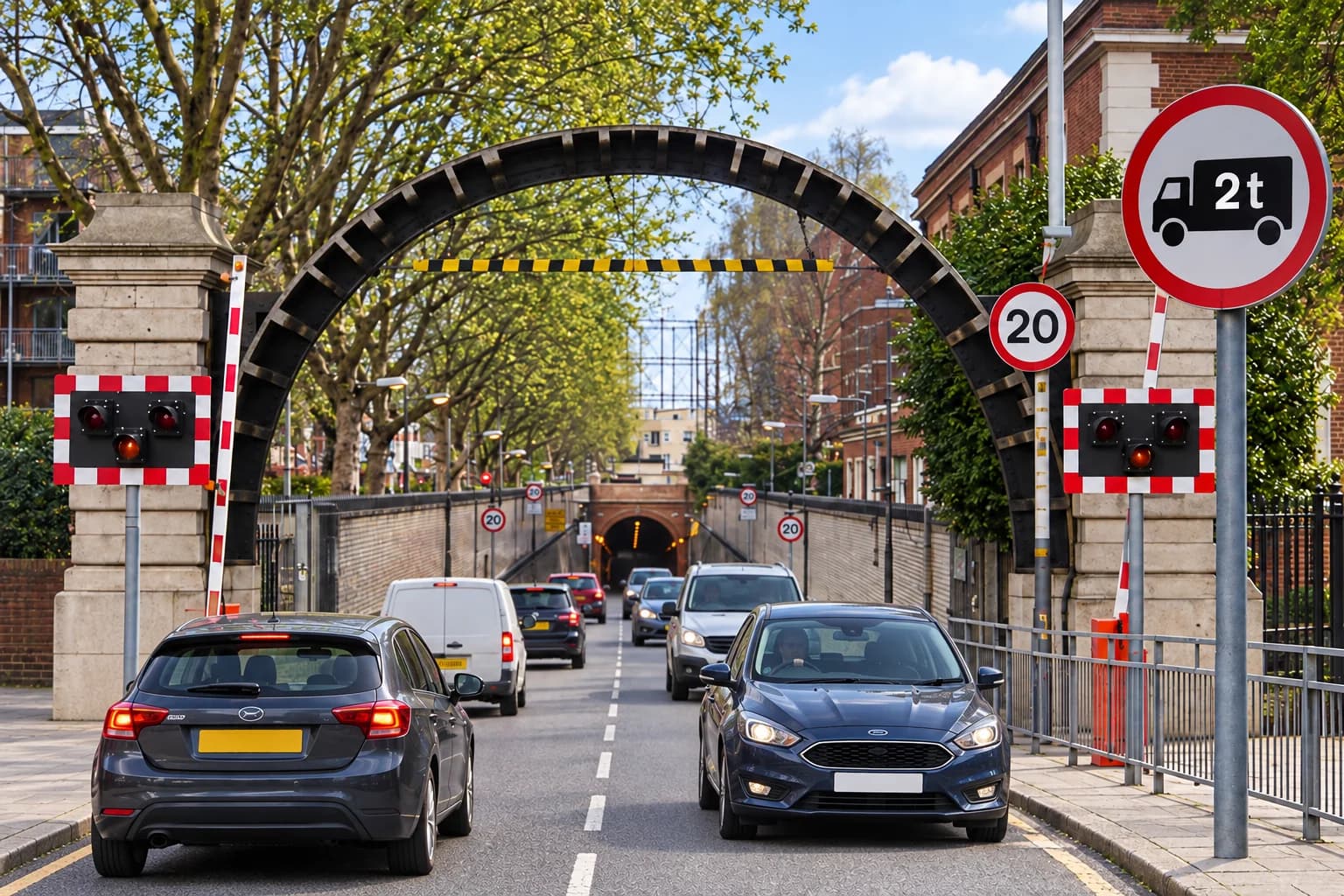
1. What does a Rotherhithe Tunnel PCN mean?
A Rotherhithe Tunnel restriction PCN concerns a prohibited vehicle using the tunnel. The goods-vehicle weight restriction applies above 2 tonnes maximum gross vehicle weight. Height and width are separate restrictions.
This is a moving-traffic restriction, not the Blackwall and Silvertown tunnels charge. Paying a tunnel charge, ULEZ or the Congestion Charge does not authorise a prohibited vehicle to use Rotherhithe.
- Restriction
- Goods vehicles exceeding 2 tonnes maximum gross vehicle weight are prohibited
- Meaning of gross weight
- The maximum loaded weight legally permitted, also called Maximum Authorised Mass (MAM)
- Height and width
- Vehicles more than 2 metres high or more than 2 metres wide are also prohibited
- Operating times
- Camera-enforced around the clock
- PCN and discount
- £160, reduced to £80 within 14 days beginning with the date of the moving-traffic PCN
- Appeal route
- Formal representations to TfL, then the Environment and Traffic Adjudicators at London Tribunals
2. Check maximum gross weight and the approach signs
Gross vehicle weight is the maximum legally permitted loaded weight. Check the revenue weight on the V5C, the manufacturer's plate or sticker, or a manufacturer confirmation. An empty van can still exceed the restriction because its plated maximum remains unchanged.
For example, a goods vehicle with a permitted maximum of 2,400 kg remains above the limit even if it weighs only 1,700 kg while empty. Those are illustrative figures: use the records for your own vehicle. A permitted maximum of exactly 2,000 kg does not exceed the weight threshold, although the separate height and width restrictions still apply.
The DVLA vehicle enquiry service lets you check the recorded vehicle details. Compare those with the V5C and plate: mass in service, unladen weight and maximum gross weight describe different things. If an entry is missing or disputed, obtain vehicle-specific confirmation from the manufacturer.
For a weight allegation, establish whether it is a goods vehicle and whether its permitted maximum exceeds 2 tonnes. Compare the camera footage and your approach photographs with the restriction in the traffic order. A generic weight estimate is not a substitute for the vehicle's records.
The goods-vehicle sign uses a lorry symbol and a weight marking inside a red circle. It is the vehicle class and marked maximum weight that matter, not whether your van looks like the pictogram. The decisions below show why relying on the picture alone has failed.
A signage challenge should identify the actual approach, the decision point and what prevented the restriction being understood there. Keep wide approach photographs as well as close-ups. Compare TfL's dated evidence with the journey date; a current image or an old internet photograph may show a different arrangement.
- The footage identifies the vehicle and shows it passing the applicable restriction.
- Vehicle classification and manufacturer records support the alleged goods-vehicle weight breach.
- Signs communicated the restriction on the route used before the restricted point.
- The traffic order, signs and allegation concern the same restriction. Check height or width separately if that is what the notice alleges.
3. Grounds for a Rotherhithe Tunnel PCN appeal
Check any claimed exemption against the traffic order applying on the date of travel. Being empty, using a van privately or following a sat-nav route does not change its maximum gross weight. Keep exceptional circumstances separate from evidence that the restriction did not apply.
- The vehicle was not in the goods-vehicle class covered by the weight restriction.
- The vehicle's maximum gross weight did not exceed 2 tonnes, supported by the V5C or manufacturer's records.
- The footage or registration reading does not establish that your vehicle passed the restriction.
- The signs on the actual approach did not adequately convey the applicable restriction, supported by dated photographs and the journey route.
- The restriction or an applicable exemption in the traffic order does not cover the alleged journey, or evidence establishes a statutory ownership or liability ground.
4. How to submit your Rotherhithe Tunnel representation
Make formal representations to TfL within 28 days beginning with service of the PCN.
Attach the V5C weight entry, a clear photograph of the manufacturer's plate, and any classification evidence. Identify the approach route and the relevant footage or sign photographs.
- Open TfL's challenge service with the PCN number and vehicle registration.
- State the ground for cancellation and upload the documents supporting it. Keep the submission confirmation and a copy of everything sent.
- For a postal representation, complete and sign the notice's representation section and send it with your evidence to Red routes, PO Box 335, Darlington, DL1 9PU. Allow time for delivery before the deadline.
- If Parking Mate UK is acting for you, provide authorisation so we can submit the representation on your behalf.
5. The 50% discount while you challenge
TfL says it puts the discount period on hold when a representation arrives within that period. If it rejects the representation, the remaining discount period resumes. For a moving-traffic PCN, the initial £80 discounted amount is available within 14 days beginning with the notice date.
[4][5]6. TfL's response and the next step
London Tribunals says the authority should normally respond to moving-traffic representations within three months. Keep your submission receipt and any request for further evidence with the case.
TfL will tell you whether the PCN has been cancelled or rejected. If rejected, use the appeal details supplied with that decision to take the case to London Tribunals.
[4][7]7. Taking your Rotherhithe Tunnel appeal to London Tribunals
After rejection, appeal within 28 days beginning with service of the rejection notice. Rotherhithe vehicle-restriction appeals go to the Environment and Traffic Adjudicators. The tribunal is independent of TfL and there is no appeal filing fee.
Use the appeal form or online verification details provided. Submit your representation, TfL's decision and the evidence supporting your vehicle classification, weight or signage ground. Review TfL's evidence pack and respond to the disputed points.
Parking Mate UK prepares and submits your tribunal appeal and helps respond to the evidence pack. If the tribunal refuses the appeal, follow the payment deadline in its decision.
[7][8]Rotherhithe Tunnel: 10 tribunal decisions explained
These ten selected 2025 Rotherhithe decisions include two allowed appeals and eight refusals. They show how adjudicators assessed vehicle weight, classification, signs, camera location and liability. This is an editorial selection, not a tunnel-wide success rate; each case turns on its own evidence.
Unidentified weight evidence failed to prove TfL's case
Case 2250243570 / 2025-08-05 / Adjudicator Chez Cotton
The appeal succeeded because TfL's weight evidence was unsatisfactory, not because a weighbridge photograph established that the van qualified.
“However, the burden is on the EA to show a contravention occurred”
Chez Cotton, case 2250243570
ROTHERHITHE TUNNEL APPROACH / BRANCH ROAD
TfL relied on an N1 classification and a stated revenue weight of 2501 kg to pursue four tunnel penalties. The appellant supplied a photograph showing a measured weight of 1860 kg with drivers and tools aboard. Chez Cotton accepted that the crossings occurred and that the signs and traffic order were adequate.
Neither side's weight evidence satisfied the adjudicator. The weighing photograph was undated and did not identify the vehicle. TfL's document lacked a DVLA heading or other indication of its origin. Its case summary could not itself establish the disputed weight. The authority therefore failed to discharge its burden of proving the contraventions.
This was a reasoned decision allowing the appeal and directing cancellation of the four PCNs, not an uncontested withdrawal. Cotton expressly warned that the result did not confirm the vehicle weighed below the restriction. The decisive issue was the quality of the evidence in this particular case.
Read the case commentaryFind case 2250243570 in the official registerCloned plates: the camera showed a different vehicle
Case 2250504481 / 2025-11-18 / Adjudicator Henry Michael Greenslade
Evidence of material vehicle differences and a police crime reference persuaded the adjudicator that the appellant's vehicle was not involved.
“find that it was not her vehicle shown to be in contravention at this time.”
Henry Michael Greenslade, case 2250504481
ROTHERHITHE TUNNEL APPROACH / BRUNEL ROAD
The camera record showed a vehicle bearing the appellant's registration at the Rotherhithe Tunnel entrance. TfL said it had passed the sign prohibiting goods vehicles above two tonnes maximum gross weight. The appellant accepted that the registration belonged to her, but disputed that the vehicle in the images was hers.
Her case was that the registration had been cloned. She identified material differences between the pictured vehicle and her own, said her vehicle was at home, and supplied supporting evidence together with a police crime reference. Henry Michael Greenslade considered the evidence and accepted her account on balance.
The appeal was allowed following an adjudicated finding about vehicle identity. It was not a finding that the weight restriction or signs were invalid, and TfL had not simply left the appeal uncontested. The case illustrates why matching a registration number and identifying the actual vehicle are different evidential questions.
Read the case commentaryFind case 2250504481 in the official registerAn 1860 kg mass-in-service figure did not establish eligibility
Case 2250272750 / 2025-11-11 / Adjudicator Henry Michael Greenslade
The vehicle document also recorded a 2910 kg revenue weight; the adjudicator distinguished that maximum figure from mass in service.
“This latter figure is not the gross maximum weight.”
Henry Michael Greenslade, case 2250272750
ROTHERHITHE TUNNEL APPROACH / BRUNEL ROAD
The appellant argued that the signs were ambiguous and that the vehicle was empty and not transporting goods. She relied on a vehicle registration document showing a mass in service of 1860 kg. She also said she had previously used the tunnel without receiving a penalty.
Henry Michael Greenslade distinguished that figure from maximum gross weight. The same registration document recorded a revenue weight of 2910 kg, or 2.91 tonnes, and an N1 classification. He explained that the restriction concerned the vehicle's maximum gross weight and that goods-vehicle status concerned its construction or adaptation, rather than whether it was carrying goods on that journey.
The appeal was refused. A genuine misunderstanding and previous uneventful journeys did not establish a ground for cancellation. The useful distinction is between two different figures on the vehicle document: evidence of a lower mass in service did not displace the recorded maximum weight.
Read the case commentaryFind case 2250272750 in the official registerHeavier passenger vehicles did not exempt an N1 van
Case 2250215316 / 2025-08-27 / Adjudicator Teresa Brennan
The adjudicator distinguished the goods-vehicle restriction from passenger-vehicle access and upheld the clarity of the prescribed weight sign.
“the Traffic Management Order prohibits goods vehicles in excess of 2 tonnes and does not prohibit passenger vehicles.”
Teresa Brennan, case 2250215316
ROTHERHITHE TUNNEL APPROACH / BRANCH ROAD
The appellant accepted driving through the tunnel in both directions but said the signs did not adequately explain the gross maximum weight restriction. TfL produced photographs from both entrances and evidence that his vehicle had N1 type approval and a maximum weight of 2159 kg.
Teresa Brennan examined the sign's red circle, lorry image and 2t marking. She found it compliant with diagram 622.1A and clear in conveying the prohibition on goods vehicles exceeding the stated maximum gross weight. The appellant also argued that many passenger vehicles had greater gross weights than his van.
That comparison did not answer the allegation. Brennan explained that the traffic order distinguished goods vehicles from passenger vehicles; their different treatment did not make this van exempt. She found both contraventions proved and refused the appeal. The reasoning concerns vehicle category as well as weight, not a universal two-tonne ban on every vehicle.
Read the case commentaryFind case 2250215316 in the official registerThe lorry pictogram did not exclude a smaller van
Case 2250158460 / 2025-07-28 / Adjudicator Louise Fisher
A recently purchased van's owner misunderstood the sign, but the tribunal found the restriction proved and the explanation amounted to mitigation.
“this misled them into thinking the restriction did not apply to their van.”
Louise Fisher, case 2250158460
ROTHERHITHE TUNNEL APPROACH / BRANCH ROAD
The appellant had bought the vehicle earlier that year and did not realise it exceeded the tunnel's weight limit. He remembered seeing a lorry picture on a sign and assumed the restriction did not apply to his van. He described the journey as a one-off mistake and said he now understood the restriction.
TfL supplied photographs of the vehicle and evidence of entrance and advance warning signs. Its DVLA evidence recorded an N1 goods vehicle with a revenue weight of 2625 kg. Louise Fisher accepted that maximum gross weight remained the relevant figure whether the vehicle was empty or full.
Fisher found the contravention proved. The appellant had produced no evidence, such as dated photographs, showing the required signs were missing or not visible on the relevant date. His explanation amounted to mitigation rather than a ground of appeal, so the appeal was refused. The sign's lorry image did not establish a van exemption.
Read the case commentaryFind case 2250158460 in the official registerThe camera location was already inside the restricted area
Case 2250002111 / 2025-03-28 / Adjudicator Louise Fisher
An argument that TfL had only photographed the approach failed because the evidence placed the entrance cameras within the restriction.
“the cameras are situated at the entrance to the Rotherhithe Tunnel, which I find to be in the restricted area.”
Louise Fisher, case 2250002111
ROTHERHITHE TUNNEL APPROACH / BRUNEL ROAD
This appeal focused on where the prohibition applied, rather than the vehicle's weight. The appellant did not dispute TfL's evidence that the goods vehicle exceeded 2000 kg maximum gross weight. Instead, he argued that photographs taken on the approach did not prove the vehicle entered the tunnel, where he accepted the restriction applied.
TfL relied on photographic captures, the PCN, a location map, legislation and correspondence. Louise Fisher also considered an authorised officer's witness statement dated 16 January 2025. It placed the cameras at the tunnel entrance, which she found was within the restricted area.
The appeal was refused because the evidence established a contravention at that location. The decision did not require a photograph taken further inside the tunnel. Its significance is the relationship between the camera position and the restriction's boundary: simply describing an image as showing the approach did not establish that it was outside the prohibition.
Read the case commentaryFind case 2250002111 in the official registerAvoiding tolls on a satnav did not avoid the weight prohibition
Case 2250205276 / 2025-09-03 / Adjudicator Graeme Wallington
The tribunal distinguished a goods-vehicle prohibition from a toll and rejected the argument that the signs omitted the weight limit.
“The restriction based upon weight is an absolute ban, not a requirement to pay a toll.”
Graeme Wallington, case 2250205276
Rotherhithe Tunnel Approach / Brunel Road
The appellant said the signs showed large trucks and dimensional restrictions without explaining the maximum weight. He also relied on using a satnav set to avoid tolls: Rotherhithe did not appear as a tolled crossing, unlike Dartford. The alleged contravention occurred on the Brunel Road approach on 4 February 2025.
Graeme Wallington found that even the appellant's own signage photograph showed a goods vehicle inside a red circle with a 2t marking. TfL's DVLA evidence identified an N1 vehicle with a revenue weight of 2830 kg. The adjudicator explained that this maximum weight did not change with the load carried.
The appeal was refused. Wallington distinguished the prohibition from a requirement to pay a toll, so the satnav setting did not answer the allegation. The decision turns on the signed vehicle restriction and recorded maximum weight, not whether the journey involved a crossing charge.
Read the case commentaryFind case 2250205276 in the official registerAn incomplete hire agreement left the keeper liable
Case 2250272003 / 2025-10-02 / Adjudicator Lola Moses
The goods-vehicle contravention was proved, and missing hire-agreement requirements prevented the hire company from transferring liability to its customer.
“the agreement does not include a signed statement from the hirer accepting liability for penalty charges”
Lola Moses, case 2250272003
ROTHERHITHE TUNNEL APPROACH / BRANCH ROAD
A vehicle hire company said its customer had the vehicle from 23 April to 27 May 2025. TfL relied on camera evidence and DVLA records identifying an N1 goods vehicle with a revenue weight of 3100 kg. Lola Moses found that it had entered the tunnel despite the two-tonne maximum gross weight restriction.
The remaining question was liability. The company's earlier account said its loan agreement had no return date because the customer was still using the vehicle. The appeal document subsequently showed due and return dates, but Moses found no evidence that a fixed hire period had been agreed at the outset.
The agreement also lacked the hirer's signed acceptance of liability for penalty charges. Moses found that the document did not meet the requirements for transferring liability, leaving the registered keeper responsible. The appeal was refused. Naming the customer and showing that a loan occurred did not resolve the missing contractual requirements.
Read the case commentaryFind case 2250272003 in the official registerRemembering the former 17-ton limit did not defeat clear signs
Case 2250250292 / 2025-09-18 / Adjudicator Mackenzie Robinson
The company relied on its understanding of an older restriction, but photographs, advance signs and road arrows established adequate warning.
“Alternative routes are available as advised by the signage and arrows on the road surface.”
Mackenzie Robinson, case 2250250292
ROTHERHITHE TUNNEL APPROACH / BRUNEL ROAD
The appellant company said it had been unaware of the changed weight restriction and believed the former 17-ton limit remained in place. Mackenzie Robinson framed the issue differently: the question was whether the change introduced by the 2018 traffic order had been adequately communicated, allowing motorists to choose another route.
The authority supplied detailed maps and photographs showing advance warning signs, directional road arrows and signs near the tunnel entrance. Robinson found that these identified the two-tonne restriction and directed drivers towards alternatives. He assessed the signage together rather than treating the company's previous understanding as decisive.
The appeal was refused. Drivers might have missed or misunderstood the signs, but the adjudicator found that the information was available and adequate. The case distinguishes familiarity with an older rule from evidence about the signs encountered on the relevant journey; past knowledge did not establish a defect in the changed restriction's communication.
Read the case commentaryFind case 2250250292 in the official registerRepeated crossings were upheld, but payment left no balance
Case 2250228770 / 2025-09-05 / Adjudicator Michael Burke
The tribunal refused the appeal while recording that TfL had accepted discounted payments in full settlement of the linked penalties.
“It follows that there is no balance to pay.”
Michael Burke, case 2250228770
ROTHERHITHE TUNNEL APPROACH / BRANCH ROAD
This reference was considered with several penalties for crossings between 5 and 17 March 2025. The vehicle's lessee said he continued using the tunnel until the leasing company first told him about a PCN on 18 March. He believed the lorry pictogram excluded vans and also criticised the signs' accessibility.
Michael Burke accepted TfL's plans and photographs as showing clear, adequate signage. The authority supplied evidence of a 2800 kg revenue weight. He found the contraventions proved and treated the explanations as mitigation. A dispute about how quickly the leasing company had notified the lessee was outside the adjudicator's jurisdiction.
The recorded outcome remained Appeal refused. Separately, TfL confirmed that it had received and accepted the reduced payment of £80 for each PCN in full and final settlement. There was therefore nothing left to pay. That financial position was not a successful appeal or an uncontested cancellation; it was settlement alongside an adverse adjudicated outcome.
Read the case commentaryFind case 2250228770 in the official registerSources and references
- TfL: Rotherhithe Tunnel restrictions
2-tonne goods-vehicle maximum gross weight, 2-metre height and width restrictions; checked 11 September 2026.
- TfL: Rotherhithe restriction signs and camera locations
Published signage and traffic-order reference; compare with the actual approach and journey date.
- London Tribunals: moving-traffic grounds of appeal
Statutory grounds and liability.
- TfL: make a traffic PCN representation
Online challenge, Red routes postal address and discount hold.
- London Tribunals: moving-traffic enforcement process
Representation and payment periods and the normal three-month response expectation.
- GOV.UK: get vehicle information from DVLA
Official vehicle enquiry service: registration, fuel type, European status, type approval and recorded weight.
- London Tribunals: moving-traffic enforcement
Independent tribunal route and appeal procedure.
- London Local Authorities and Transport for London Act 2003
Schedule 1: representations and appeals.
About Parking Mate UK
We assess a Rotherhithe PCN against the vehicle's permitted maximum weight, classification and the evidence from the approach used. Your representation addresses the actual allegation, rather than relying on how lightly the vehicle was loaded.
Send us your Rotherhithe Tunnel PCN for a free assessment. Our automated appeal platform prepares your documents, submits your representation, tracks deadlines and handles the tribunal appeal, with support online and on WhatsApp.
For court, Traffic Enforcement Centre and bailiff matters, we prepare documents for you to review, sign and send where required.
Check Your PCN