Parking Mate UK
Parking Ticket on Private Land. Your Rights Explained
Private land parking charges are contract law, not criminal law. Covers your rights including appeal routes, time limits, and when charges become unenforceable.
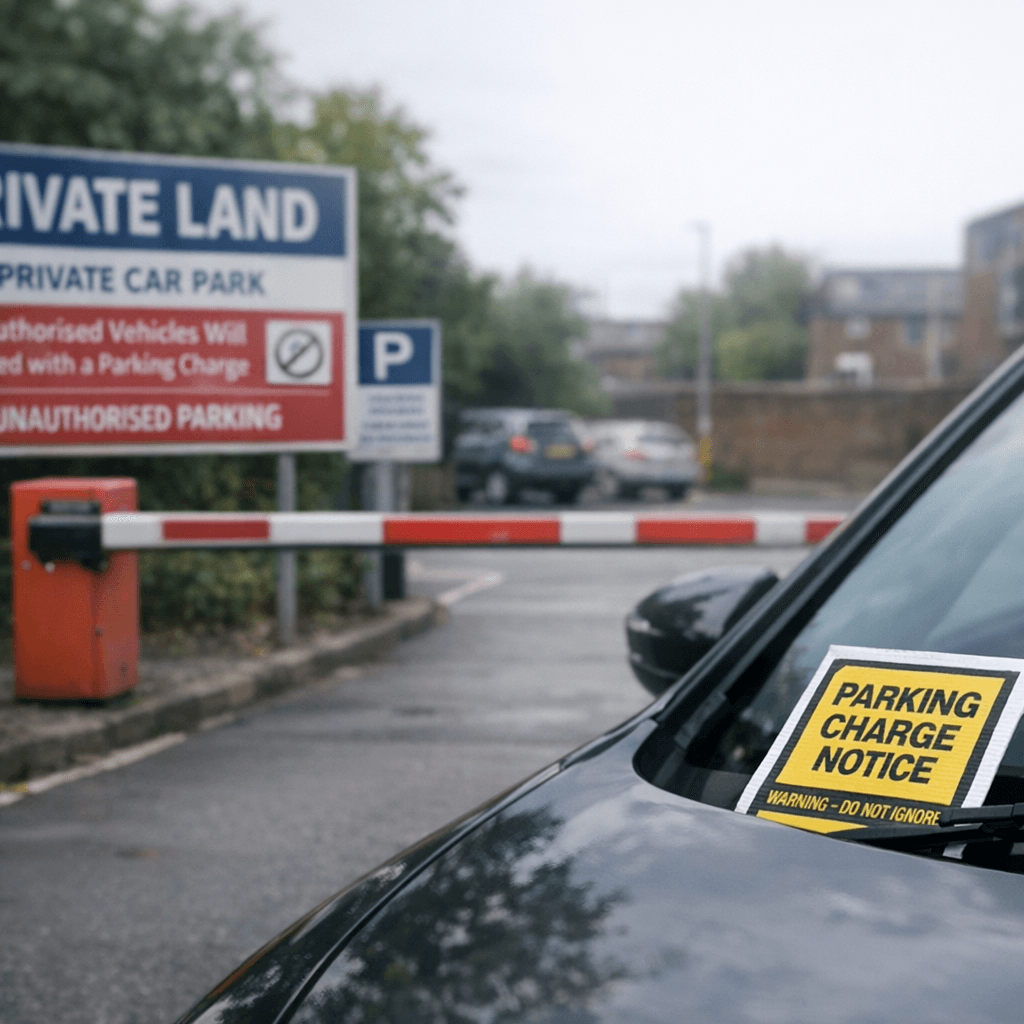
Private Land Parking Is Contract Law, Not Criminal Law
A parking charge issued on private land (supermarkets, hospitals, retail parks, private estates) is fundamentally different from a council penalty charge notice. Understanding this distinction is essential for knowing your rights.
The Key Difference
Council PCN (public land): A statutory penalty issued under the Traffic Management Act 2004. It is a regulatory fine with enforcement powers including bailiffs.
Private parking charge (private land): An invoice based on alleged breach of contract. The operator claims you agreed to parking terms by entering the car park and then breached those terms. It is a civil matter, not a crime.
Your Rights on Private Land
- It is not a fine. A parking charge notice from a private operator is an invoice. The word "fine" applies to criminal or statutory penalties only.
- You have the right to appeal. All BPA and IPC member operators must provide an appeal process. BPA operators offer escalation to POPLA. IPC operators offer escalation to IAS.
- The operator must prove the contract. The burden is on the operator to show that clear terms were displayed, you saw them, and you breached them.
- POFA 2012 protections apply. If the NTK was late, missing the required declaration, or defective, the charge is unenforceable against the keeper.
- The charge must be proportionate. Following ParkingEye v Beavis [2015], charges must represent a genuine pre-estimate of loss, not a penalty.
- You cannot get points on your licence. Private parking charges do not affect your driving record.
- Bailiffs cannot be sent for private charges. Only a county court judgment can lead to enforcement. The operator must take you to court first.
What the Operator Must Prove
To enforce a private parking charge, the operator must demonstrate:
- They had authority from the landowner to enforce parking 2. The terms were clearly displayed on adequate signage 3. The motorist had the opportunity to see and understand the terms 4. A contravention occurred (supported by evidence) 5. The NTK was served within 14 days with a valid POFA declaration
If any of these elements fail, the charge is vulnerable to appeal.
Check Your Rights
Upload your private land parking charge for a full assessment. Parking Mate UK checks all five requirements automatically.