Parking Mate UK
Pedestrian zone entry and waiting appeals
Code 54 PCN Appeal: Pedestrian Zone Entry and Waiting Restrictions
Received a Code 54 PCN for a pedestrian zone? The entry times, access or loading exceptions and separate waiting controls determine what your vehicle could do. Parking Mate UK checks the signs, CCTV and traffic order, then prepares and submits your formal representation.
Start with a free Code 54 assessment. Our £9.99 Automated Penalty Charge Appeal Service includes preparing and submitting your formal representation and tribunal appeal.
Check Your PCN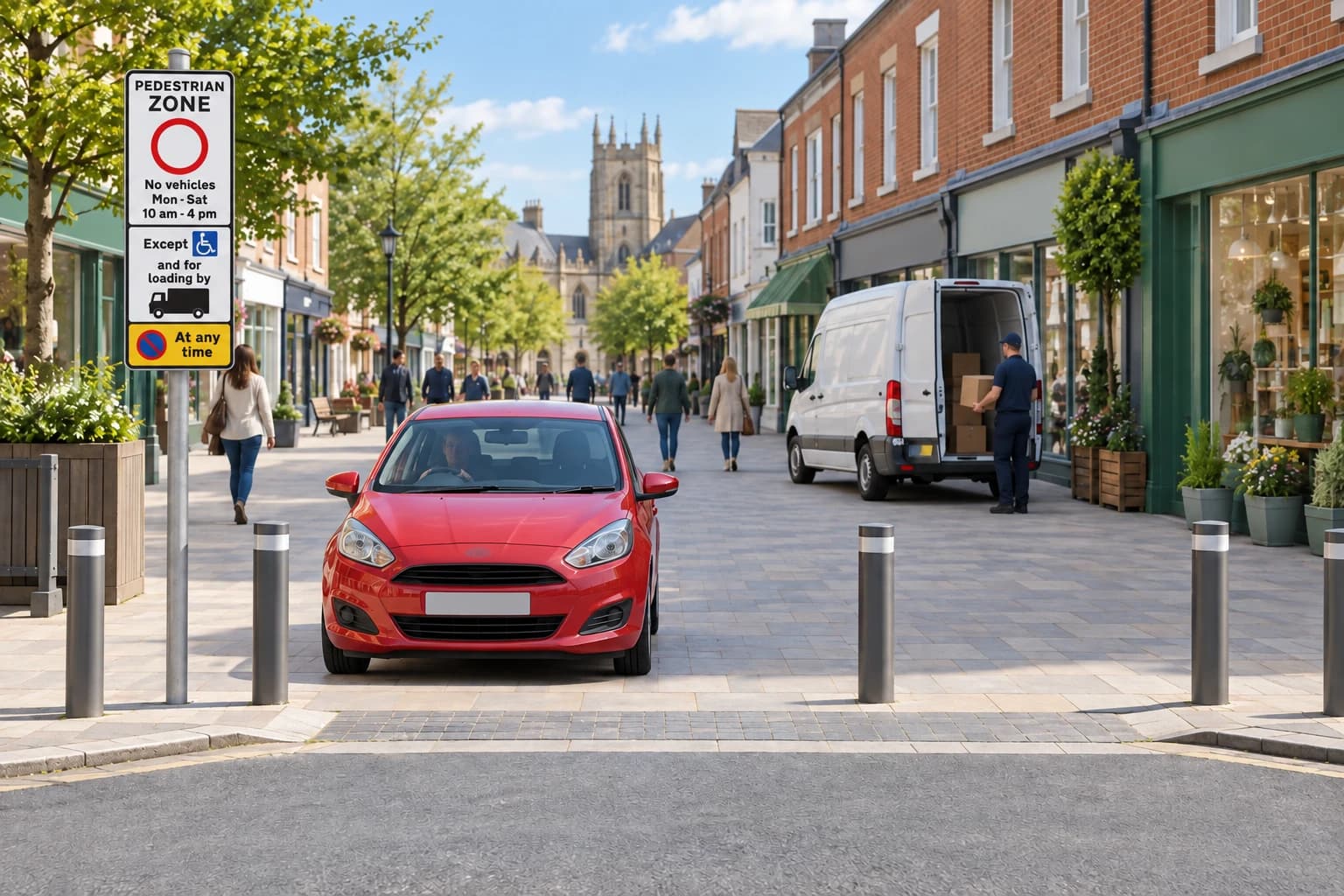
1. What does contravention Code 54 mean?
Code 54 concerns a restriction on vehicles entering and waiting in a pedestrian zone. These zones can cover shopping streets or other roads set aside for pedestrians, sometimes with access for deliveries, permit holders or other specified vehicles. The description may include a pedestrian and cycle zone.
Code 53 is the entry-only description. Code 54 brings the zone's entry and waiting controls into the allegation, but that does not mean every PCN requires proof that a vehicle both entered unlawfully and then parked. Establish which restriction the authority says was broken. A prohibited entry is not answered simply by saying you did not stop.
Permission to enter does not necessarily permit waiting anywhere inside. Equally, a vehicle may enter before the entry restriction starts but later be subject to a waiting restriction. Match the movement or waiting shown in the evidence to the actual order and sign panels.
- Contravention
- Code 54: failing to comply with restrictions on vehicles entering and waiting in a pedestrian zone
- Code 53 or 54?
- Code 53 describes entry restrictions; Code 54 describes entry and waiting restrictions. Read the complete allegation and the controls actually in force.
- Main evidence
- Entry sign panels, separate waiting or loading signs, the operative traffic order, CCTV and evidence of any access permission
- Penalty amount
- London: £160, reduced to £80 during the initial discount period. England outside London: £60 or £70, reduced to £30 or £35, according to the applicable charging band. Follow the notice for Wales and the discount deadline.
- Representations
- For a London Code 54 PCN, the authority must receive your representation within 28 days of service of the PCN
- Appeal route
- Formal representations to the issuing authority; after rejection, London Tribunals in London or the Traffic Penalty Tribunal under the relevant schemes elsewhere
2. Which signs apply to a Code 54 restriction?
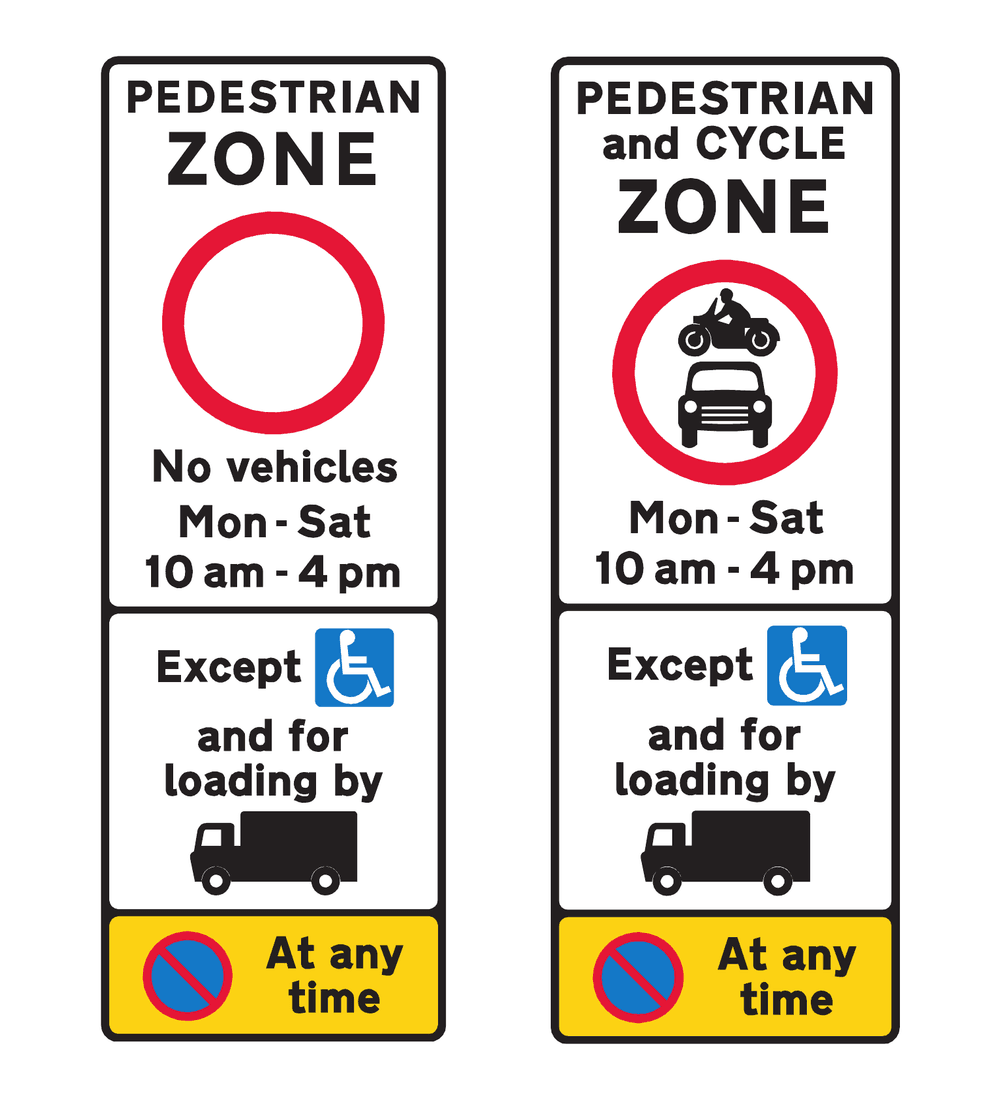
Diagram 618.3B is the pedestrian-zone entry sign with a red-ringed 'no vehicles' symbol. Diagram 618.3C is the pedestrian and cycle zone sign with the car-and-motorcycle symbol: ridden cycles are permitted. These are Schedule 8 Part 2 items 1 and 2 of TSRGD 2016.
Read the panels separately. The upper panel gives the entry restriction and its operating period. The middle panel gives exceptions, such as access, loading or permit holders, and may have its own times. The lower yellow panel gives a waiting restriction, which may last longer than the entry restriction.
A loading exception shown in the middle panel is not the same as unrestricted parking. Loading prohibitions, where imposed, are signed inside the zone rather than on the entry sign. Waiting controls may be signed within the zone without yellow lines where the relevant arrangement applies.
The lower panel can lawfully be omitted. Read any waiting signs and markings inside the zone and check the PCN's description against the actual scheme. An omitted panel or an older pedestrian-zone heading does not, by itself, establish that the notice must be cancelled.
3. What must the authority prove?
The notice, legal restriction, sign evidence and recording must identify the same road, time and activity. For Code 54, distinguish evidence of crossing the entry boundary from evidence of waiting inside it.
- An operative restriction: the order must cover the relevant road, extent, direction and hours, including amendments and the definitions of any permitted access or loading. A sign cannot fill a missing operative period in the order.
- The activity alleged: the recording must identify the vehicle and establish the movement or waiting relied upon. If a vehicle only turns at the entrance, compare the precise manoeuvre with the order's wording and boundary.
- Adequate signs on the actual approach: check the full sign face, its panels and the point where it becomes readable. Schedule 8 Part 5 direction 2 places the sign as near as practicable to where the restriction begins or ends.
- The relevant waiting controls: check the zone-entry panel and any internal signs, loading restrictions or bay conditions. An entry exception and a waiting exception are separate questions.
- Visibility and lighting: check dated photographs for obstruction, orientation and legibility. Schedule 8 Part 1 paragraph 2 imposes conditional direct-lighting requirements on roads above 20 mph within 50 metres of a street-lighting lamp; it is not a rule that every zone sign needs its own lamp.
- Liability and notice: check the owner or qualifying hire position, the allegation, service and the applicable legal scheme.
4. Grounds for appealing a Code 54 PCN
Base your representation on the particular restriction and the evidence. Separate a legal ground from a request that the authority exercise discretion.
- The order does not establish the alleged restriction: identify the missing hours, incorrect road schedule, boundary mismatch or relevant amendment.
- An access, loading or permit exception applied: provide the exact provision, sign wording and evidence that the journey met its purpose, destination and timing conditions.
- The restriction was not operating: distinguish the entry hours, exception hours and waiting hours rather than relying on just one time panel.
- The signs did not adequately communicate the controls: show the actual approach, obstructions and point at which the panels became readable, with dated photographs or footage.
- The recording does not prove the alleged activity: identify missing footage, a boundary or manoeuvre issue, or a mismatch between what the order prohibits and what the vehicle did.
- You were not the liable owner, or a qualifying hire arrangement applies: provide the relevant dated transfer or hire documents and liability statement.
5. Access, loading, permits and waiting exceptions
The sign may permit buses, taxis, access, loading, specified permit holders or disabled badge holders. The wording can restrict loading to goods vehicles or limit an exception to particular hours. Use the actual sign and order rather than assuming every pedestrian zone has the same exceptions.
For a delivery, retain the job record, destination and timing evidence. Where access to premises is permitted, show that the journey was genuinely for that access. Explain any necessary stop and why it falls within the applicable provision; permission to reach premises does not automatically permit waiting outside them.
A Blue Badge, a nearby destination or a delivery job is not a universal exemption. Where a permit is required, check that it covered the vehicle, zone and date. Emergency or essential-service exemptions may be in the order without appearing on the sign.
A satnav route or a brief visit does not itself create permission. Explain exceptional circumstances to the authority where discretion is needed, but do not present mitigation as a statutory exemption.
[2][3][5][11]6. How to make a formal representation
For a London Code 54 PCN, submit formal representations to the issuing authority using the details on the notice. London Tribunals states they must be received "within 28 days of the date the Penalty Charge Notice is served".
Outside London, use the submission route and deadline on the notice under the applicable English or Welsh scheme.
- Open the official evidence and challenge portal shown on the PCN. Enter the notice reference and vehicle registration.
- Review the complete CCTV. Record the boundary crossed, time, route and any waiting or loading, then obtain photographs of the full entry sign and relevant signs inside the zone.
- State the ground and the specific issue: order wording or hours, visibility, permitted access, loading, waiting conditions, proof of the movement or liability. Attach the supporting photographs and documents.
- Identify missing evidence needed to resolve the dispute. Submit by the deadline and keep the full representation, attachments and dated acknowledgement.
Will appealing affect the 50% discount?
The 50% reduction is an early-payment discount, not a discount for making an appeal. Check the reduced amount and payment deadline on your PCN before deciding whether to pay or challenge it. The discount deadline and the deadline for representations are not necessarily the same.
An early challenge may give you another opportunity to pay the discounted amount if it is rejected. Check the issuing authority's policy and the terms of its reply; a renewed discount is not automatic for every notice. Submit through the correct challenge route and keep the dated confirmation.
If you take the case to the tribunal, do not assume the discount remains available. An allowed appeal cancels the penalty. If the appeal is refused, the full penalty is normally payable. Read the rejection and tribunal decision for the payment instructions.
7. How long does the authority have to respond?
London Tribunals states that the authority "should normally respond to representations within 3 months".
For formal representations under England's 2022 regulations outside London, the authority must serve its decision within 56 days of receiving them. Welsh Government guidance also states a 56-day response period under the separate Welsh regulations.
[6][7][8][14]8. Check the Notice of Rejection and evidence
The Notice of Rejection should explain why the authority rejected your representation and provide the tribunal appeal instructions. Check that it answers the issue you raised: the operative hours, the panel you relied on, the boundary or the scope of an access exception.
Where the authority relies on loading hours to reject a separate access claim, compare the two provisions carefully. Where waiting is disputed, check the internal restrictions and the activity recorded. An explanation about entry signs alone may not resolve that question.
Record the date of service and appeal deadline. Keep the PCN, representation, acknowledgement, rejection and evidence together, and compare the authority's tribunal evidence pack with the disputed points.
[6][9][11]9. Taking a Code 54 appeal to the tribunal
For a London PCN, register your appeal with London Tribunals within 28 days beginning with service of the Notice of Rejection. Use its verification details, select the relevant ground and explain how the order, sign panels or CCTV supports your case.
Outside London, the Traffic Penalty Tribunal handles the relevant English and Welsh schemes. Use the appeal details in the rejection. Both tribunals are independent and normally charge no appeal fee; if the appeal is refused, the full penalty is normally payable.
Organise your evidence in sequence: the restriction and sign panels, the vehicle's route and any stop, the claimed exception, and the notice history. Use a previous decision to illustrate the specific issue, not as proof that every PCN in a pedestrian zone should be cancelled.
[6][9][10]Recent Code 54 tribunal decisions
Two allowed appeals and one refusal show why the order's operative hours and the precise scope of an access exception matter. Full case details and authority attribution are available in each commentary.
Missing prescribed hours left the alleged restriction unsupported by the order
Case 225042869A / 2025-12-12 / Adjudicator Edward Houghton
The appeal was allowed because the order schedule did not specify prescribed hours for the road. Clear signage could not supply the missing operative restriction.
Read the case commentary“and the position is that there is currently no restriction in force on that road.”
Edward Houghton, case 225042869A
A separate access exception was not limited by the loading hours
Case 2250313643 / 2025-10-30 / Adjudicator Michael Burke
The authority relied on loading hours, but its own sign evidence showed a separate, untimed access exception. The supported delivery journey was not rebutted.
Read the case commentary“I am not satisfied the Enforcement Authority have rebutted the claim to exemption and accordingly I allow the appeal.”
Michael Burke, case 2250313643
The access exception did not cover waiting outside the destination
Case 2250374557 / 2025-12-19 / Adjudicator Carl Teper
The appeal was refused because the access exception did not cover the vehicle's waiting at the two positions shown outside the destination. The stated reason for waiting did not establish an exemption.
Read the case commentary“Whilst the signage indicates an exemption for Vicarage Fields, it does not include waiting outside the gates of Vicarage Fields.”
Carl Teper, case 2250374557
2025 London Tribunals Code 54 results
13 of 42 recorded cases were allowed (31.0%).
| Recorded outcome | Cases |
|---|---|
| Allowed | 13 |
| Refused | 29 |
| Total | 42 |
Sources and references
- Standard contravention codes
Code list PDF page 2: Code 53 entry-only wording and Code 54 entry-and-waiting wording. PDF page 5: suffix c adds 'and cycle'.
- TSRGD 2016, Schedule 8
Part 2 items 1-2: diagrams 618.3B and 618.3C, permitted panel variations; items 3-4: end signs. Part 1 paragraphs 1-2; Part 5 directions 1-2. Supplied statutory PDF pages 128-131 and 136 checked.
- Traffic Signs Manual, Chapter 3 (2019)
Chapter 3 section 6, printed pages 57-63 (PDF pages 59-65): entry, exception and waiting panels; one-sign visibility assessment; internal waiting/loading signs; older signs. Guidance, not an automatic-cancellation checklist.
- Local Authorities' Traffic Orders Regulations 1996
Regulation 18: information about the effect of an order and maintenance of signs.
- London Local Authorities and Transport for London Act 2003
Section 4 and Schedule 1: scheduled section 36 signs, prescribed orders, owner liability, representations and appeals.
- London Tribunals: moving-traffic PCN enforcement
London representations, response expectation and independent appeal stages.
- DfT: moving-traffic enforcement outside London
English moving-traffic procedure under the 2022 scheme.
- England's 2022 Representations and Appeals Regulations
Decision period for qualifying formal representations; not London's 2003 Act procedure.
- London Tribunals: preparing your appeal
Evidence and statutory grounds for the independent appeal.
- Traffic Penalty Tribunal: moving-traffic PCNs
Relevant appeal schemes outside London.
- London Tribunals: registers of appeals
Search the selected case references. Statistics use the supplied 2025 cohort, exact label 'Fail comply restrict vehicles enter/wait ped zone', unique references and decision dates. Attribution is retained in the separate case articles.
- London-wide parking and traffic charges
Current moving-traffic charge: £160, with the applicable 50% early-payment reduction. Borough increases took effect on 7 April 2025.
- England's 2022 charging guidelines
Schedule 3 paragraphs 1-2: higher-level moving-traffic charges, bands of £60 or £70 and their 50% discounted amounts; apply the correct local band.
- Welsh Government: moving-traffic enforcement guidance
Paragraphs 92-93: formal representations and the 56-day response period under the separate Welsh regulations.
- TSRGD 2016, Schedule 4
Part 3 item 4: pedestrian-zone waiting prohibition on a yellow panel. Part 4 item 1: loading prohibition on a white panel. Part 2 paragraphs 23-24 on combined panels; read with TSM Chapter 3 section 6.3.
About Parking Mate UK
We assess real Code 54 decisions to identify the evidence that matters in a pedestrian-zone appeal: the order's entry and waiting controls, the sign panels, the vehicle's activity and the conditions of any access exception.
Our 2025 entry-and-waiting restriction analysis covers 42 London Tribunals decisions: 13 allowed and 29 refused. These cases help us distinguish a missing operative restriction or supported access claim from activity that falls outside the exception.
Send your Code 54 PCN for a free assessment. Parking Mate UK prepares and submits your formal representation and handles your tribunal appeal, with support online and on WhatsApp.
Check Your PCN