Parking Mate UK
AM Parking Services IAS Appeal — Why NTK Terminology Matters
AM Parking Services used “Notice to Owner” instead of “Notice to Keeper” — a critical POFA 2012 terminology defect that invalidated the entire charge. Learn why one wrong word can make a private parking notice non-compliant.
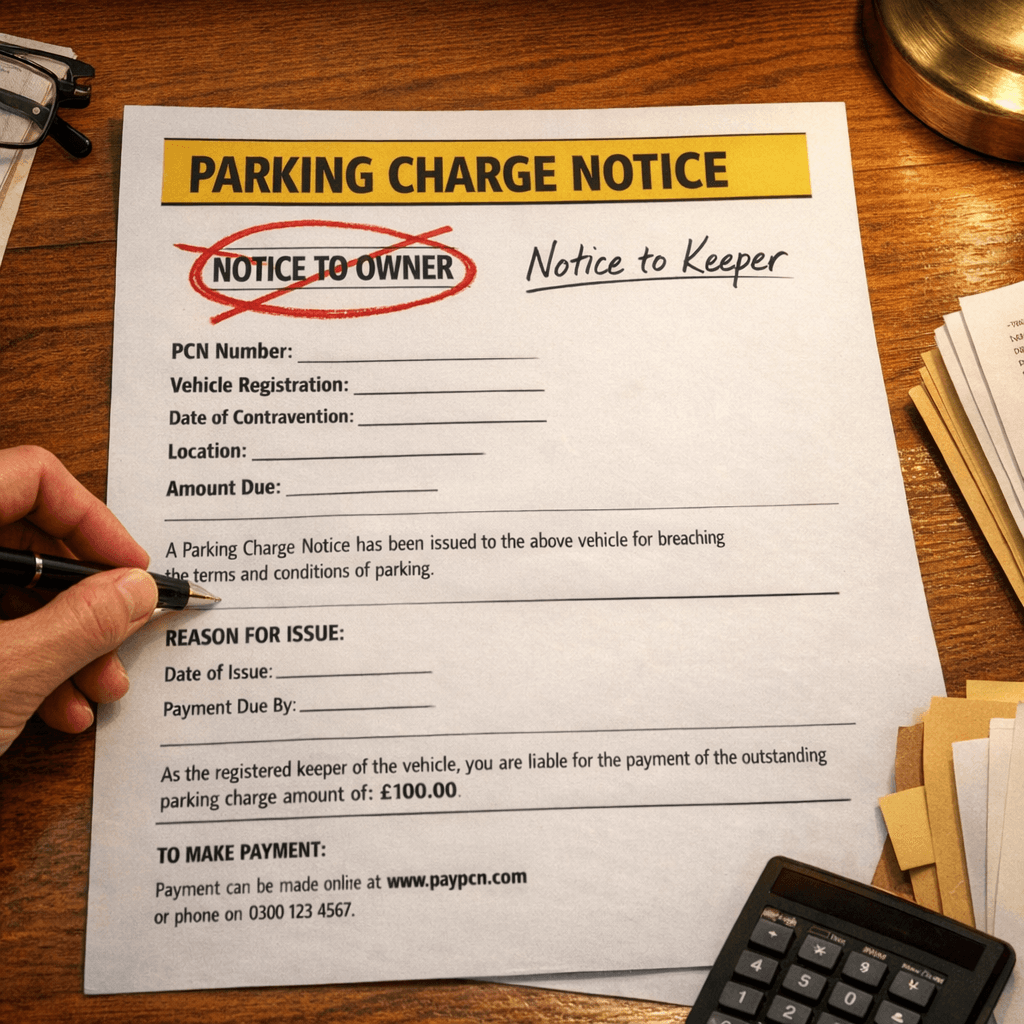
In private parking enforcement, the difference between one word and another can determine whether a charge is legally enforceable. This case study examines how a motorist successfully appealed a parking charge from AM Parking Services by identifying a critical terminology defect: the operator used "Notice to Owner" instead of "Notice to Keeper."
The Charge
A motorist parked at Bank House in Tonbridge, Kent — a site managed by AM Parking Services. The alleged contravention was failure to display a valid parking permit. AM Parking issued a parking charge notice and subsequently sent what they described as a “Notice to Owner” (NTO) to the registered keeper of the vehicle, demanding payment.
The motorist challenged the charge through the Independent Appeals Service (IAS), the appeals body used by operators who are members of the International Parking Community (IPC).
The Critical Defect: Wrong Terminology
The appeal identified a defect that may seem minor on the surface but is legally significant: AM Parking Services used the term “Notice to Owner” on their correspondence to the registered keeper.
Why does this matter? Because “Notice to Owner” is not a term that private parking operators are entitled to use. It is a statutory term with a specific legal meaning under an entirely different enforcement regime.
“Notice to Owner” vs “Notice to Keeper” — The Legal Distinction
There are two parallel systems of parking enforcement in the United Kingdom, and each uses its own terminology:
Council enforcement (public land): Local authorities issue Penalty Charge Notices (PCNs) under the Traffic Management Act 2004 (TMA 2004). When a council needs to pursue the registered keeper, they issue a “Notice to Owner” (NTO) — a statutory document with prescribed content defined by regulations.
Private enforcement (private land): Private parking operators issue Parking Charge Notices under a contractual model. When a private operator needs to pursue the registered keeper, they must use the mechanism provided by the Protection of Freedoms Act 2012 (POFA), Schedule 4. Under POFA, the document sent to the registered keeper is a “Notice to Keeper” (NTK) — not a “Notice to Owner.”
The distinction is not merely semantic. The NTO and NTK are governed by different legislation, have different prescribed content requirements, and carry different legal consequences. A private operator that issues a “Notice to Owner” is using a statutory term it has no authority to use, which creates two problems:
- It misrepresents the nature and authority of the notice, potentially misleading the recipient into believing the notice has statutory force
- It demonstrates that the operator’s documentation does not comply with POFA 2012, because a compliant notice would use the correct terminology
POFA 2012 Schedule 4 Requirements
The Protection of Freedoms Act 2012, Schedule 4, sets out the conditions that a private parking operator must meet before it can hold the registered keeper liable for a parking charge. These conditions include:
- The keeper liability notice (NTK) must be given within 14 days of the vehicle leaving the land (or within 28 days if the DVLA response is delayed)
- The NTK must contain prescribed information, including the amount of the charge, the grounds for the charge, and how to appeal
- The original notice (affixed to the vehicle or sent to the driver) must state that the operator may obtain keeper details from the DVLA
If any of these conditions is not met, keeper liability does not transfer. The operator can only pursue the driver — and in most cases, they cannot identify the driver.
The Second Defect: Missing DVLA Statement
The appeal also identified a second POFA compliance failure. The original notice to the driver did not include the required statement that the operator may request keeper information from the DVLA. This is a separate prescribed requirement under POFA Schedule 4, and its absence is an independent ground for finding that keeper liability has not been established.
This is a common defect across many private parking operators. The statement must appear on the notice given to the driver at the time of the alleged contravention — it cannot be added later in correspondence.
The IAS Decision
The Independent Appeals Service reviewed the evidence and the legal arguments. The terminology defect and the missing DVLA statement, taken together, demonstrated that AM Parking Services had not complied with the requirements of POFA 2012. The appeal was upheld.
Why This Matters for Every Motorist
This case illustrates a principle that applies across all private parking charges: the details matter. Private parking operators must follow specific legal procedures if they want to pursue the registered keeper, and the legislation does not allow for approximation or shortcuts.
Key takeaways:
- Check every word. If a private operator sends you a “Notice to Owner,” that is an immediate red flag. Private operators issue Notices to Keeper under POFA 2012 — NTOs are reserved for council enforcement under TMA 2004.
- Check for the DVLA statement. The original notice (whether affixed to your windscreen or sent by post) must state that the operator may obtain your details from the DVLA. If it does not, keeper liability may not transfer.
- Check the 14-day window. The NTK must be received within 14 days of the parking event (subject to the 28-day extension where the DVLA response is delayed). Late notices fail the POFA test.
- One defect is enough. You do not need to find multiple failures. A single POFA non-compliance issue is sufficient to defeat keeper liability.
The Broader Pattern
AM Parking Services is not the only operator to make this mistake. The confusion between “Owner” and “Keeper” terminology appears across multiple operators, suggesting a systemic failure in compliance processes. For motorists, this represents a readily identifiable and legally robust ground of appeal.
When checking your own parking charge, start with the basics: Is it a Notice to Keeper or a Notice to Owner? Does the original notice mention the DVLA? Was the NTK sent within 14 days? These three checks alone can determine whether the operator has a valid claim against you.
Upload your parking charge to Parking Mate AI and we’ll check it for free.