Parking Mate UK
Euro Car Parks POFA Challenge — 8 Legal Defects Found on One Notice
A detailed POFA compliance analysis of a Euro Car Parks charge at Nathan Way, Thamesmead revealed 8 distinct legal defects on a single notice — from missing vehicle photos to incorrect location details. One of the most thorough private parking appeals ever produced.
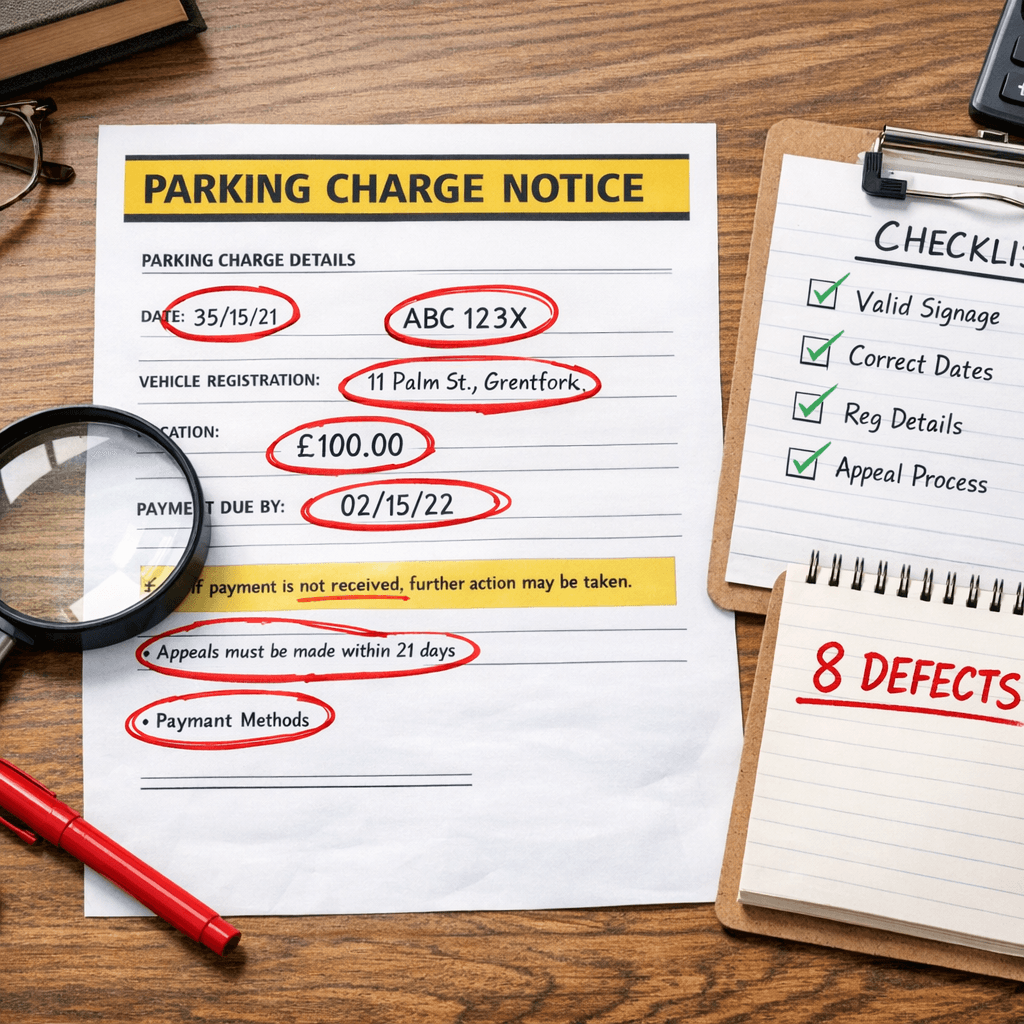
When a motorist received a parking charge notice from Euro Car Parks for an alleged parking contravention at Nathan Way, Thamesmead, they brought it to Parking Mate UK for analysis. What we found was extraordinary: eight distinct legal defects on a single notice, each representing a failure to comply with the requirements of the Protection of Freedoms Act 2012. This case is one of the most thorough private parking appeals in our collection and serves as a masterclass in systematic POFA compliance checking.
The Parking Charge
The motorist received a parking charge from Euro Car Parks Limited relating to a vehicle parked at Nathan Way, Thamesmead. The operator alleged that the vehicle had been parked in contravention of the terms and conditions displayed at the site.
On initial review, the notice appeared to be a standard private parking charge. However, a detailed legal analysis against the requirements of POFA 2012 Schedule 4 and the relevant Code of Practice revealed a catalogue of failures.
The 8 POFA Defects Identified
Each of the following defects represents a separate failure by the operator to comply with the legal requirements for pursuing the registered keeper of the vehicle:
Defect 1: No Vehicle Photograph or Registration Displayed
The notice failed to include a clear photograph of the vehicle or properly display the vehicle registration mark. Under POFA 2012, the operator must provide sufficient evidence to identify the vehicle in question. A notice that does not clearly show the vehicle or its registration is fundamentally deficient.
Defect 2: No Period of Parking Specified
The notice did not specify the period during which the vehicle was alleged to have been parked. The operator must state when the vehicle arrived and when the alleged contravention was observed. Without this information, the motorist cannot verify whether a contravention actually occurred or whether any grace period should have been applied.
Defect 3: Creditor Not Identified
The notice failed to properly identify the creditor — that is, the party to whom the charge is owed. Under the POFA framework, the notice must make clear whether the charge is owed to the landowner, the parking operator, or another party. Ambiguity about the creditor can render the notice non-compliant.
Defect 4: No Discount for Early Payment
The Code of Practice requires operators to offer a discounted rate for early payment, typically a 50% reduction if paid within 14 days. The notice in this case did not include any early payment discount, which is a breach of the operator’s obligations under their Code of Practice membership.
Defect 5: Signage Not Shown or Referenced
The notice did not include images of the signage at the site or make any meaningful reference to the specific signs that the motorist allegedly failed to comply with. The operator must be able to demonstrate that adequate signage was in place and that the terms and conditions were clearly communicated. A failure to reference or evidence the signage undermines the entire basis of the charge.
Defect 6: Location Incorrectly Identified
The notice contained a discrepancy in the location of the alleged contravention. The address was stated as 119/121 Nathan Way, but the actual managed site covers 101-121 Nathan Way. This may seem like a minor point, but accuracy matters in legal notices. If the operator cannot correctly identify the location of the alleged contravention, it casts doubt on the reliability of the entire enforcement process.
Defect 7: Grace Period Not Applied
Under the relevant Code of Practice, operators must allow a grace period (typically 10 minutes) before issuing a charge. The notice showed no evidence that any grace period had been applied. If the vehicle was observed for less than the required grace period before the charge was generated, the notice should not have been issued.
Defect 8: No Explanation of How Charges Became Payable
The notice failed to explain how the charges became payable — that is, what specific term or condition was breached and how the stated charge amount was calculated. Under POFA 2012, the notice must contain sufficient information for the keeper to understand the basis of the claim against them. A bare demand for payment without explanation is insufficient.
The POPLA Appeal
The appeal was submitted to POPLA (Parking on Private Land Appeals), the independent appeals service for members of the British Parking Association. The appeal set out all eight defects in detail, with specific references to the relevant provisions of POFA 2012 Schedule 4 and the BPA Code of Practice.
When an appeal identifies this many distinct legal failures, the operator faces an almost impossible task in defending the charge. Each defect independently undermines the validity of the notice, and together they present an overwhelming case for cancellation.
Why Systematic Checking Works
Most motorists who challenge parking charges focus on one or two arguments — perhaps the signage was unclear, or they had a reasonable excuse for parking where they did. This approach can work, but it leaves the operator room to argue that the charge is still valid on other grounds.
A systematic POFA compliance check is different. By examining every element of the notice against the statutory requirements, you identify every point of failure. This approach has several advantages:
- Multiple independent grounds — If one argument fails, the others still stand. The operator must address every defect, not just the strongest one.
- Demonstrates the operator’s overall competence — Eight defects on one notice suggests systemic failings in the operator’s enforcement process, not an isolated error.
- Shifts the burden to the operator — When faced with a detailed, multi-point compliance challenge, operators must produce evidence of compliance for each point. Many cannot.
What This Means for Your Parking Charge
If you have received a parking charge from Euro Car Parks or any other private parking operator, do not assume the notice is legally valid just because it looks official. Many notices contain multiple defects that are not immediately obvious to a non-specialist.
The key areas to check on any private parking charge include:
- POFA timeframe compliance (28-56 day window for NTK)
- Content requirements of the NTK
- Evidence of signage at the site
- Accuracy of location and vehicle details
- Grace period application
- Early payment discount availability
- Identification of the creditor and basis of the charge
- Photographic evidence quality
Key Takeaway
This Euro Car Parks case at Nathan Way, Thamesmead is proof that a thorough, systematic approach to checking POFA compliance can reveal defects that operators do not expect to be found. Eight legal failures on a single notice is exceptional, but finding two or three defects is common. Every defect strengthens your position and makes it harder for the operator to sustain the charge.
Upload your parking charge to Parking Mate AI and we’ll check it for free.