Parking Mate UK
Code 50L, 50R and 50U appeals
Code 50 PCN Appeal: How to Challenge a Prohibited Turn PCN
Received a PCN for a banned left turn, right turn or U-turn? A Code 50 appeal turns on the exact manoeuvre, the prohibition at that junction and the signs you could see before turning. Parking Mate UK checks the camera evidence, signs and traffic order, then prepares and submits your formal representation to challenge a prohibited-turn PCN.
Start with a free Code 50 PCN assessment. Our £9.99 Automated Penalty Charge Appeal Service includes preparing and submitting your formal representation to the authority and your tribunal appeal.
Check Your PCN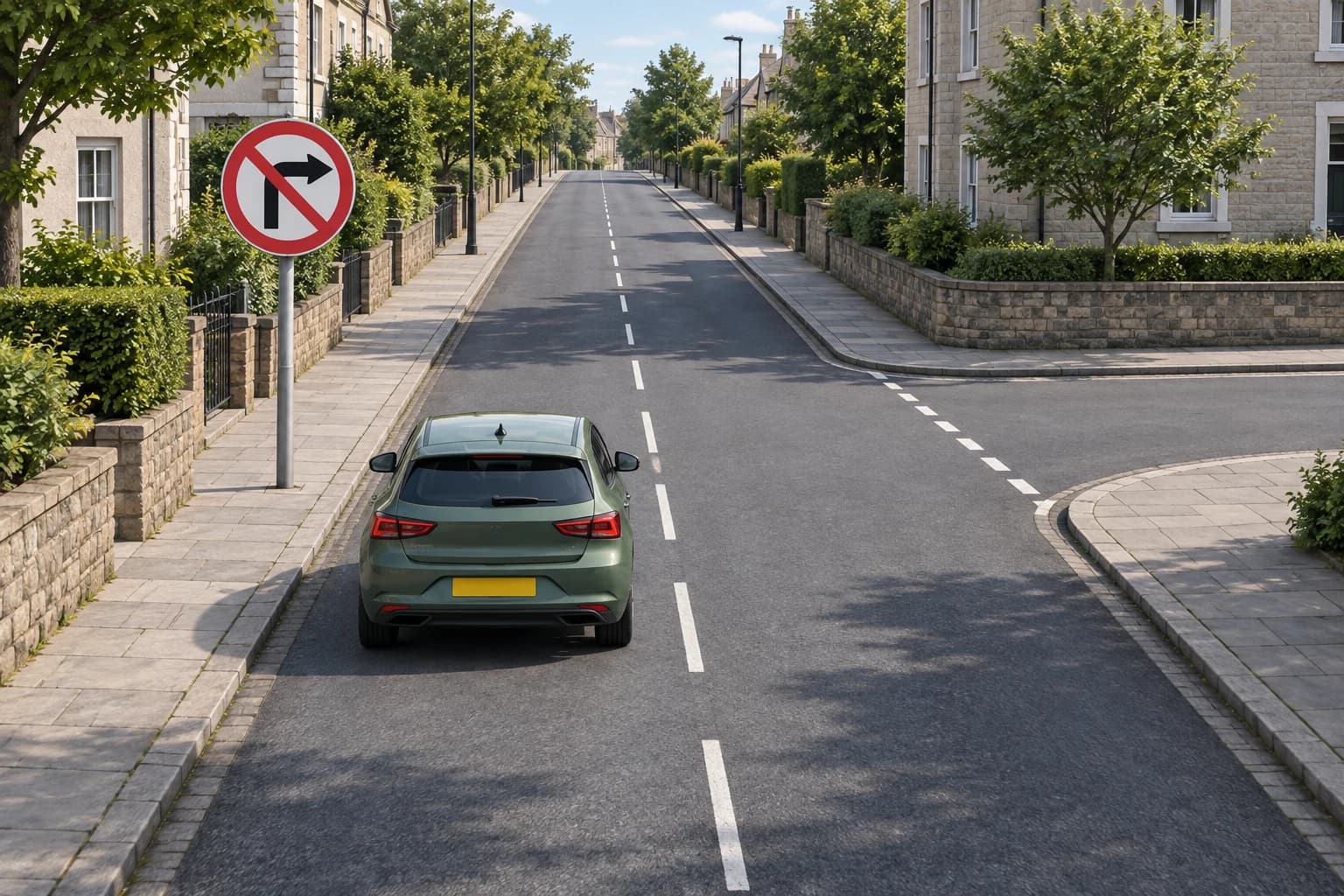
1. What does contravention Code 50 mean?
Code 50 means performing a prohibited turn. The authority alleges that your vehicle made a turning movement which was banned at that location: 50L identifies a prohibited left turn, 50R a prohibited right turn and 50U a prohibited U-turn. Read the full description on the PCN, not just the number.
The important question is not simply whether your vehicle turned. It is whether the movement shown in the evidence was the movement prohibited by the restriction. Turning into a nearby driveway, turning around inside a side road and turning at the named junction are not automatically the same manoeuvre.
A green traffic light does not override a prohibited-turn sign. Following a satnav, completing the turn safely or finding the road empty does not, by itself, answer the allegation.
[1][5]- Contravention
- Code 50: performing a prohibited turn
- Variants
- 50L left turn; 50R right turn; 50U U-turn
- Category
- Moving-traffic contravention
- Evidence
- The recorded turn, approach signs and applicable restriction
- Challenge deadline
- London and England's 2022 scheme: within 28 days of service. For Wales, follow the notice and Welsh procedure.
- Appeal route
- Formal representations to the issuing authority. After rejection: London Tribunals in London, or TPT under the relevant schemes elsewhere in England and Wales.
2. Which signs apply to a prohibited turn?
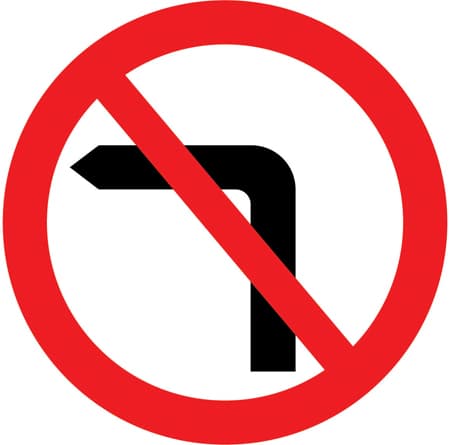
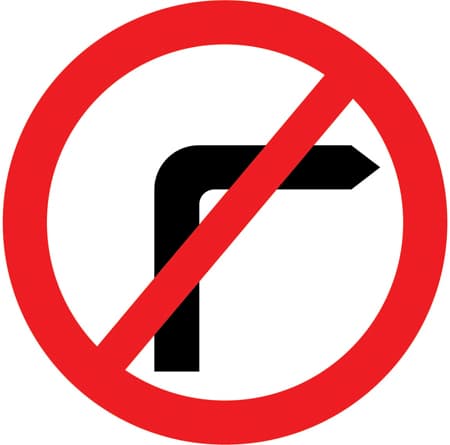
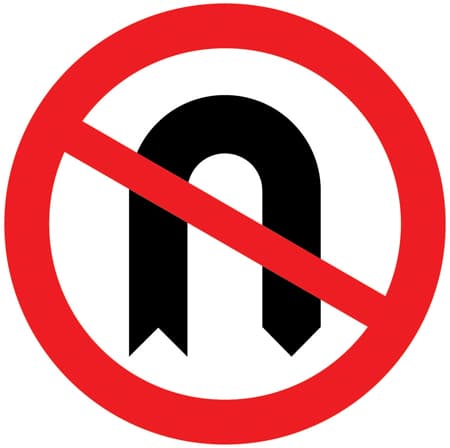
Match the sign to the turn alleged on your PCN. The prescribed circular signs show a black turning arrow crossed by a red diagonal bar: diagram 613 for no left turn, diagram 612 for no right turn and diagram 614 for no U-turns. Read any permitted supplementary plate with the sign: it can identify the operating times, an exception or, for a U-turn restriction, the length of road covered.
An ahead-only arrow is a different instruction. Do not substitute an ahead-only allegation for the prohibited turn on your notice, or assume that every nearby directional arrow proves the restriction being enforced.
3. What must the authority establish?
For a Code 50 PCN, the restriction, its signing and the evidence of your turn need to fit together. A sign photographed somewhere near the junction is not the whole case.
A restriction covering this turn
Ask for the Traffic Management Order (TMO), also called a Traffic Regulation Order (TRO), where the turn ban is imposed by an order. Check the operative article, road schedule, amendments, commencement date, direction of travel, hours and exceptions. The wording must cover the movement and location alleged, not a different junction or a different approach.
TSRGD Schedule 3, Part 5, direction 1 links these signs to an underlying prohibition or restriction imposed by a statutory provision, order or another listed legal instrument. A TMO is the usual starting point, but the authority should identify the actual legal instrument it relies upon. A missing copy in an initial reply does not itself prove that no restriction exists.
[2][4]Signs that adequately communicate that restriction
For an order governed by the 1996 Traffic Orders Procedure Regulations, regulation 18 requires the authority to place and maintain signs giving road users adequate information about its effect. Compare the actual signing with the order: the prohibited direction, operating hours and any exception must tell a consistent story.
The Traffic Signs Manual explains placement. For an unsignalised left- or right-turn restriction, Chapter 3 paragraph 4.5.3 places the sign immediately before the junction, normally on the left. Paragraph 4.2.9 explains the use of a prohibited-turn sign at an unsignalised T-junction. A second sign or advance warning can be appropriate to the layout; there is not a blanket rule that every Code 50 junction must have two signs.
For no U-turns, Chapter 3 paragraphs 4.11.1-4.11.3 distinguish a junction, a gap in a central reservation and a restriction extending along a road. The guidance on placement, distance plates and repeat signing differs accordingly. Signal-controlled junctions require the signal-specific arrangements to be checked too. The Manual is guidance; distinguish its recommendations from mandatory TSRGD directions.
[4][3]Visibility from the driver's approach, including at night
Photograph what could be seen before the turn, from the lane and direction used. Include foliage, scaffolding, parked vehicles, the angle of the sign and any competing information. A close-up showing a readable sign does not necessarily establish that an approaching driver could read it in time.
Lighting is conditional. For the relevant Schedule 3 signs, Part 4 paragraph 4 contains a direct-illumination requirement where the road's speed limit is above 20 mph and the sign is within 50 metres of a street-lighting lamp, subject to the stated exceptions and operating conditions. Check those facts before alleging a lighting defect. There is no universal rule that every turn sign needs its own lamp.
Road arrows may reinforce the message. Their absence is not automatically a defence to a prohibited turn: identify any marking actually required for the installation rather than importing yellow-line or parking-bay rules.
[2][3]Evidence of the prohibited movement and a properly issued notice
Check the vehicle registration, junction, direction of movement, date and time against the allegation. The footage or other evidence must establish the turn relied upon. Ask for the continuous recording where still images leave the approach or completed manoeuvre unclear.
The authority must also use the applicable enforcement power and serve a notice meeting its statutory requirements. London moving-traffic PCNs under the 2003 Act and notices issued under the English or Welsh civil-enforcement regulations do not share every procedural rule.
[6][9]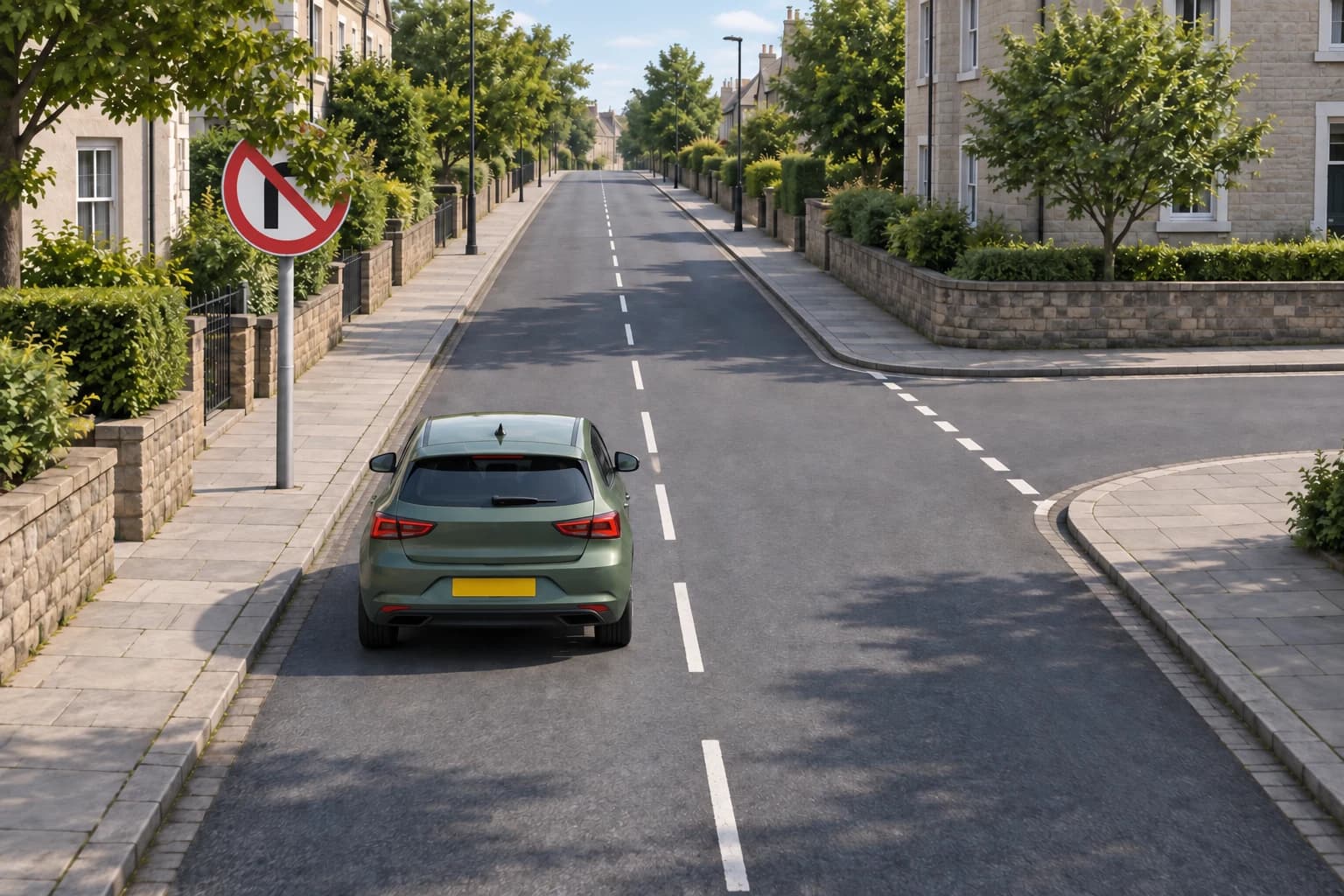
Same approach, different visibility. These illustrations explain the issue; your appeal needs evidence from the actual junction.
4. Grounds for appealing a Code 50 PCN
Connect each argument to a ground available under the legislation on your PCN. For a disputed turn or inadequate signing, the central ground is usually that the alleged contravention did not occur.
- Wrong manoeuvre or location: the evidence does not show the prohibited turn alleged, or shows a different access point outside the restriction.
- Inadequate signs: the restriction was not adequately conveyed on your approach. Identify the particular obstruction, position or inconsistency and support it with photographs.
- Restriction not operating: the recorded time falls outside the turn ban, or the order did not cover that direction or was not in force on the relevant date.
- Applicable exception: the vehicle or use fell within an exception in the governing instrument. Identify the exact provision and supporting record.
- Owner or hire liability: you were not the liable owner at the material time, the vehicle was used without consent, or the statutory hire provisions apply. Use documents that address liability, not merely the identity of another driver.
- Penalty or procedural defect: explain the specific statutory failure. Procedural impropriety is an express ground under the English 2022 scheme; it is not a separately listed ground under the London 2003 Act. Frame a London argument under its applicable grounds rather than copying a parking template.
5. Which exemptions can apply?
There is no general exemption allowing a prohibited turn simply because a driver lives nearby, holds a Blue Badge, is delivering goods or was following navigation instructions. Read the exception for this turn, not a permission relating only to entry into the surrounding area.
- A signed vehicle exception, such as qualifying buses, taxis or cycles: check the order's definition and whether your vehicle or journey qualifies.
- An express access or authorised-vehicle exception: establish that it applies to the turn itself, and supply the relevant authorisation.
- Emergency use or an authorised traffic direction: identify the applicable legal provision and evidence of what actually happened. For London 2003 Act enforcement, section 4(12) addresses use for fire brigade, ambulance or police purposes; it is not a general exemption for any urgent journey.
Where the circumstances are mitigation rather than a legal exemption, explain them to the authority and ask it to exercise discretion. Do not present a request for sympathy as proof that the contravention did not occur.
[3][6]6. How to make a formal representation
Submit your Code 50 formal representations to the issuing authority using the form or address on the PCN. For a London notice, the authority must receive them within 28 days of service of the PCN.
- Identify the PCN, vehicle registration, location and alleged left turn, right turn or U-turn. State the statutory ground you rely on.
- Describe the actual manoeuvre. Point to the relevant footage timestamps and, where needed, an annotated junction plan.
- Explain the particular defect or exemption. For signing, show the driver's approach and the sign's position. For an order issue, identify the road, direction, operating hours or exception which does not match the allegation.
- Attach your evidence and make targeted requests for missing material: the recording, contemporaneous approach photographs and the operative order provisions are more useful than a generic demand for every council document.
- Ask the authority to cancel the PCN. Save your submitted text, attachments and dated acknowledgement. An evidence request or a council complaint is not necessarily registered as formal representations.
Outside London, use the deadline and submission instructions on the notice under the applicable English or Welsh scheme.
[7][8][11]Will appealing affect the 50% discount?
The 50% reduction is an early-payment discount, not a discount for making an appeal. Check the reduced amount and payment deadline on your PCN before deciding whether to pay or challenge it. The discount deadline and the deadline for representations are not necessarily the same.
An early challenge may give you another opportunity to pay the discounted amount if it is rejected. Check the issuing authority's policy and the terms of its reply; a renewed discount is not automatic for every notice. Submit through the correct challenge route and keep the dated confirmation.
If you take the case to the tribunal, do not assume the discount remains available. An allowed appeal cancels the penalty. If the appeal is refused, the full penalty is normally payable. Read the rejection and tribunal decision for the payment instructions.
7. How long does the authority have to respond?
The response rule depends on the legal scheme, not on the number 50 alone.
London: normally within three months
London Tribunals says the authority should normally respond to formal representations within three months.
[7]England outside London: the statutory 56-day rule
For formal representations under England's 2022 regulations outside London, the authority must serve its decision within 56 days of receiving them.
[8][9]Wales: use the Welsh procedure
Welsh moving-traffic PCNs are governed by separate regulations. Welsh Government statutory guidance states that the authority must serve its decision within 56 days of service of the representations. Use the Welsh statutory provisions for a Welsh Code 50 PCN, not the English 2022 regulations.
[11][12]8. What should a Code 50 Notice of Rejection address?
A Notice of Rejection is the authority's formal decision on your representations. Read it alongside your actual argument. If you disputed a no-right-turn sign on one approach, a general explanation of why the authority enforces moving traffic does not answer that particular point.
- The authority must consider the representations and supporting evidence. Check whether its reasons address the turn, restriction, sign visibility, hours or exemption you raised.
- The notice must give the applicable payment and tribunal-appeal information, including the time limit and how to appeal. For the London 2003 Act scheme, Schedule 1 also prescribes the warning about a Charge Certificate and information concerning an adjudicator's power to award costs.
- Where evidence is disputed, identify what remains missing and why it matters. For example: which photograph shows the sign facing your approach on the relevant date, and which order provision prohibits the turn shown?
Do not assume the law requires every requested document to accompany the rejection, or that an unanswered request automatically cancels the PCN. At tribunal, the authority must disclose the evidence it relies on through the applicable process. Preserve the missing-evidence point, but lodge the appeal in time rather than waiting indefinitely for a reply.
[6][10][8]9. Taking a prohibited-turn appeal to the tribunal
You normally appeal after receiving a Notice of Rejection, within 28 days beginning with its service. The tribunal depends on the issuing authority and legal scheme; it is not a choice between two appeal providers.
London Tribunals
For London moving-traffic PCNs, use the Notice of Rejection's verification details to register an Environment and Traffic Adjudicators appeal online, or use the supplied appeal form. Identify the disputed turn and answer the authority's reasons. London Tribunals says the authority must send you its evidence at least five days before the scheduled hearing or decision.
[10]Traffic Penalty Tribunal
For the relevant local-authority schemes in England outside London and Wales, register with the Traffic Penalty Tribunal using the details on your rejection. Upload the PCN, representations, rejection and supporting evidence, then follow the tribunal's directions for further comments or a hearing.
[11]Explain the evidence, not just the conclusion: show the movement, the relevant sign or order provision and the defect in the authority's answer. Previous decisions can illustrate an argument, but the adjudicator decides your own evidence and circumstances. If you are late, explain why and request permission; do not assume it will be granted.
[10]10. Prohibited-turn cases: why two appeals succeeded and one failed
These London Tribunals decisions from December 2025 illustrate the difference between a supported signage argument and simply not noticing a lawful sign. The quotations are from the adjudicators' reasons held in our decisions archive. These are tribunal examples, not claims that Parking Mate represented the appellants.
A no-right-turn sign which did not adequately address the driver's approach
Case 2250435094 · 31 December 2025 · Adjudicator Anju Kaler
The adjudicator considered a driver who had entered a side road to turn around. The only no-right-turn sign was on the left. On the evidence of this layout and approach, the signing was inadequate.
Read the case commentary“I find the signage inadequate and allow the appeal.”
Anju Kaler, case 2250435094
The evidence photograph did not show the prohibited-turn sign relied upon
Case 2250422682 · 27 December 2025 · Adjudicator Michael Burke
A plan and annotated photographs challenged whether the right turn was signed. The adjudicator was not satisfied that signage prohibited the actual turn and allowed the appeal.
Read the case commentary“The Enforcement Authority have provided a photograph but this does not show the signage relied upon.”
Michael Burke, case 2250422682
Not noticing a lawful no-left-turn sign did not establish a ground of appeal
Case 2250463125 · 30 December 2025 · Adjudicator Laura Marshall
The authority supplied the traffic order, footage, still images and sign photographs. The adjudicator found a prohibited left turn proved; not focusing on the sign and causing no obstruction did not establish a legal defence.
Read the case commentary“I accept the evidence of the Enforcement Authority and find the signage to be lawful and adequate.”
Laura Marshall, case 2250463125
11. How did prohibited-turn appeals turn out in 2025?
Our 2025 prohibited-turn records contain 1,535 decisions: 443 appeals allowed and 1,092 refused. That is 28.9% allowed.
| Recorded outcome | Decisions |
|---|---|
| Appeal allowed | 443 |
| Appeal refused | 1,092 |
| Total | 1,535 |
London Tribunals prohibited-turn decisions recorded in the 2025 portion of our two-sided archive. Counts use the workbook's decision/outcome date and one unique case reference per record, not the number of PCNs issued by authorities or the year an appeal was first lodged. Allowed outcomes include cases the authority did not contest. These are not a Parking Mate success rate or a prediction for an individual PCN.
Sources and references
- Contravention codes and suffixes
Code 50: prohibited turns; L, R and U suffixes.
- Traffic Signs Regulations and General Directions 2016
Schedule 3, Part 2 items 6-8; Part 4 paragraph 4; Part 5 direction 1. Also check the applicable signal-mounted provisions for a signal-controlled junction.
- Traffic Signs Manual, Chapter 3 (2019)
Paragraphs 4.2.9, 4.3, 4.4, 4.5.3 and 4.11: prohibited turns, exceptions, plates and placement. Guidance, not a substitute for the regulations.
- Local Authorities' Traffic Orders (Procedure) (England and Wales) Regulations 1996
Regulation 18: traffic signs giving adequate information about the effect of an order, and maintenance.
- The Highway Code: signs and road junctions
Rules 171 and 176: signs at junctions and traffic signals. A green signal remains subject to applicable signs.
- London Local Authorities and Transport for London Act 2003
Section 4, including subsection (12); Schedule 1: representations, rejection and appeals.
- London Tribunals: moving-traffic enforcement process
Representation period, grounds, consideration and normal three-month response period.
- Civil Enforcement of Road Traffic Contraventions (Representations and Appeals) (England) Regulations 2022
Regulations 5-7: representations, authority duties and adjudicator appeals. These are the English regulations, not the London 2003 Act or Welsh scheme.
- DfT: bus-lane and moving-traffic enforcement outside London
Statutory guidance: accurate orders and signs, representations, procedural impropriety and 56-day decisions.
- London Tribunals: preparing your appeal
Registration, verification code, appeal deadline and exchange of evidence.
- Traffic Penalty Tribunal: moving-traffic PCN and appeal process
England outside London and Wales: representations, rejection and tribunal appeal.
- Welsh Government: civil enforcement of bus-lane and moving-traffic contraventions
Paragraphs 92-93: formal representations within 28 days of service and a decision within 56 days of service of the representations; the separate Welsh 2013 regulations apply.
- London Tribunals statutory registers
Search the case references shown above. Decisions can subsequently be reviewed or corrected.
- Department for Transport: traffic-sign artwork
Diagrams 612, 613 and 614 reproduced accurately. Crown copyright, used under the Open Government Licence.
Statistics: Parking Mate UK decisions archive, two-sided 2016-2026 workbook, Data sheet filtered to 2025 and Performing a prohibited turn. Case references and quotations are provided above. Sign artwork is Crown copyright; scenario illustrations are original Parking Mate UK artwork.
About Parking Mate UK
Powered by Parking Ticket Appeal OS
We assess real London Tribunals decisions to identify strong grounds for challenging Code 50 PCNs: signs hidden from the driver's approach, restrictions that do not cover the manoeuvre, and camera evidence that does not establish the alleged turn.
Our 2025 prohibited-turn analysis covers 1,535 decisions: 443 appeals allowed and 1,092 refused. Those findings help us focus your representation on the signs, traffic order and evidence that matter to your particular left turn, right turn or U-turn.
Parking Mate UK provides an automated platform to challenge your penalty charge. Simply send us your Code 50 PCN for a free assessment. We prepare and submit your formal representation to the authority and handle your tribunal appeal, so you do not have to work through the process alone.
Check Your PCN